
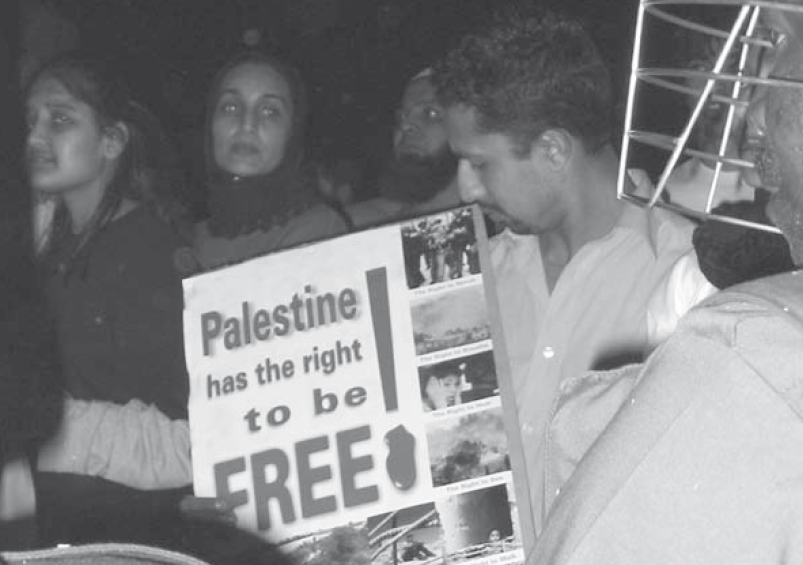
The Palestine Solidarity Committee* gives a concrete account of the impact of the Occupation on Palestinian women’s lives.
Introduction
The months since January 2003 has seen an escalation of attacks by the Israeli occupying forces against Palestinian civilians in densely populated refugee camps and other civilian areas throughout the West Bank and Gaza. Israeli forces have attacked, invaded and placed under siege at least 12 key Palestinian cities and refugee camps in the first two weeks of March alone. They have used heavy weaponry in intensive strikes that has resulted in a high number of civilian casualties and fatalities: at least 170 dead and over 500 injured between January 2003 and March 2003.
There has also been arbitrary arrests of all male Palestinians between the ages of 14 and 48. Inhuman and degrading methods including blindfolding, handcuffing, strip-searching and writing of numbers on their arms have been used during these arrests. There has been extensive destruction of property, without military necessity. This has included destruction and damage to civilian homes, workplaces, hospitals, ambulances, clinics, schools, universities, churches and mosques as well as to key infrastructure including water pipes and electricity lines.
Palestinian women have experienced this oppression together with their communities and have often suffered additional indignities and humiliations specific to women. While being forced to challenge and confront the Israeli occupation they have often, at the same time been forced to challenge, respond to and sometimes, simply tolerate the conservative nature of their society with regard to their own roles as women.
Girl and Women Political Prisoners
By 9th March 2003, 65 Palestinian women remained in the notorious Neveh Terzah section of Ramleh Prison. Of the 65 Palestinian women being detained, ten are girls under the age of 18, held in conditions that contravene international standards of detention. This is contrary to the Convention on the Rights of the Child, which stipulates that all individuals under the age of 18 are considered children, and must not be submitted to forms of torture or cruel, inhuman and degrading treatment, nor should they be deprived of their liberty except as a last resort. The youngest of the detainees, Zainab Al Shouly and ‘Aisha Abeyat, both turned 15 whilst in prison.
Another women prisoner, Mirvat Taha was immediately forced back to her prison cell after giving birth to her first child in a hospital a few kilometers away from the prison. She is denied minimal living standards, as are the other fifty Palestinian women political prisoners detained by Israel. Mirvat is refused the necessary heath care for herself and her newborn son.
The Addameer Prisoners Support and Human Rights Association points to an apparent pattern in which Palestinian women are now being detained in order to place pressure on relations who may
be ‘wanted’ by Israel, or under interrogation. This was evident in the case of ‘Abla Sa’adaat, wife of PFLP General Secretary Ahmad Sa’aadat, who was detained on her way to the World Social Forum and only released weeks later.
The conditions of detention in which Palestinian women are held are inhumane. Any attempt from female detainees to protest their conditions of detention is met by collective punishment. In July 2002 female detainees began a hunger strike in protest of these conditions. In response, the Prisons Authorities threw tear gas canisters into the women’s small cells, causing numerous injuries amongst the detainees. Four of the female detainees were transferred to other prisons and placed in isolation.Family visits have been prevented for over a year permits for families of female detainees to travel from the West Bank to Ramleh Prison in Israel, where Palestinian female detainees are held in contravention of the Fourth Geneva Convention, have not been issued. The women are commonly held in solitary confinement.
The Physical Health of women
The health of women has been affected by inadequate access to health care, closures of health centres, inadequate food and medical supplies and loss of income.
A study by Reema Katana,in September 2002 for the Palestinian National Parliament found that the inability of female doctors and nurses to reach their places of work since the start of the intifada in September 2000 has resulted in the closure of many Mother and Child health care centres and the destruction of their health care programmes.
Pregnant women are particularly at risk. Since the beginning of the second intifada, 51 women have given birth at military checkpoints. About twenty-nine newborn babies did not survive the trauma. This has resulted in an increase in the number of women delivering their babies at home, to avoid the security checkpoints. Nearly 29.3 per cent of all deliveries now take place in the home without adequate medical supervision.
There is an increase in anaemia cases among women, reaching 74.2 per cent among pregnant women aged 15 to 49, and 45.4 per cent among non-pregnant women. This is a result of the great difficulty in acquiring food because of the siege and curfews as well as the loss of income. Anaemia in pregnant women has caused early births and low weight amongst newborn babies. Many women, suffering from cancer, kidney problems or other diseases have also suffered from complications and some have died, because they were not allowed to make the journey to hospitals for treatment.
Women’s experience of House Demolitions
In what is still a mostly-traditional culture with distinct divisions of labour, a majority of women see their role within the home as a crucial and defining one. The home is the symbol of security and protection for the family and the place over which women can legitimately exercise individual power.
The Committee Against House Demolitions says that Palestinian women become even more powerless with the loss of their homes. After the demolition, the Palestinian woman will usually have to live with her husband’s family. She has lost her world in a physical and in a social sense too. She is no longer in charge but lives in someone else’s house, and has to take on the subordinate status of a daughter to her mother-in-law. Many have said that they experience the loss of their homes as though they were being raped.
The economy and the changing role of women
About 50% of all Palestinians live below the poverty line. The closure of the Palestinian territories has forced more than 100 000 families into abject poverty, forcing them to survive on less than R16 per day. Each employed Palestinian now supports at least 10 people on a single income.
With many men out of work, in prison, killed or injured during this second intifada, the responsibility for feeding the family is increasingly falling to women. There are now significantly more women in the workplace.
Currently, 35% of Gazan women work outside the home. But this ‘liberation’ through necessity has created a fatal imbalance in many relationships. It has also created an explosion in domestic violence, mental health problems and “honour killings”.
“Unemployed men feel helpless and frustrated, so the women feel they have a double burden of providing for their family financially and emotionally. The violence undertaken by Israel against Palestinian men is then revisited on their wives and children. They have to combat domestic violence as well as political violence,” says Shadia el Sarag from the Gaza community mental health programme.
Conclusion
In spite of these conditions Palestinian women remain vocal and active in their support for an end to the Occupation and the establishment of an independent Palestinian state. On International Women’s Day, 8th March 2003, about 300 women protested against the occupation and the war against Iraq. The demonstration was coordinated by women’s organizations such as the Rural Women’s Development Society, the General Union of Palestinian Women, and the Palestinian Working Women Society for Development. Women chanted slogans demanding an equal and active role in Palestinian society.
Most women believe that it is the establishment of a Palestinian state with a constitution under which every citizen’s rights are guaranteed,that will allow them the opportunity and means to fight for and advance women’s rights and living standards.
* The Palestine Solidarity Committee is a national campaign organisation dedicated to raising conciousness about the struggle for freedom in Palestine, and to building solidarity between the Palestinian people and social movements in South Africa.
Leave a Reply
You must be logged in to post a comment.