
Seumas Milne* discusses the Iraq resistance movement’s plans to unite and form a public political platform. This article is based on an interview held with some of the resistance leaders in Damascus, Syria.
In Iraq, suicide attacks and sectarian killings grab the world’s attention. But it is the guerrilla war being waged by the Iraqi resistance that is having such a devastating effect on US and British forces. Now these insurgent groups want to create a united front and a political platform.
The meeting takes place in Damascus. Dr Zubeidy is a hunted man. His picture has been shown on Iraqi TV as a wanted terrorist. Since Shia militia came to his house in Baghdad to kill him last year – and kidnapped and murdered his brother-in-law when they realised that he was not home – he has rarely slept in the same place twice and always carries fake identity documents. His children have changed schools often this has had a psychological impact on them. Zubeidy, a medical doctor, was imprisoned under Saddam Hussein for hiding and treating a friend who fought with an official from Saddam’s Ba’athist regime. He was released in a general amnesty in the run-up to the US-British invasion.
Leaders
Sitting next to Zubeidy, is Abdallah Suleiman Omary, an engineer with a map of the al-Ghazaliya area of Baghdad, where he lived until recently. A political leader from Iraqi Hamas – a Fallujah trader who uses the nom de guerre Abu Ahmad – participates in the conversation that lasts for nine hours. All three have come recently from Iraq and are uncertain of how open to be in this interview as they edge towards a public profile for the Iraqi resistance.
Zubeidy is the political spokesman of Ansar al-Sunna, an Islamist armed group with a ferocious reputation in Iraq. Omary is head of the political department of the 1920 Revolution Brigades, a more nationalist organisation whose name commemorates an uprising against British rule after the First World War.
A war of attrition
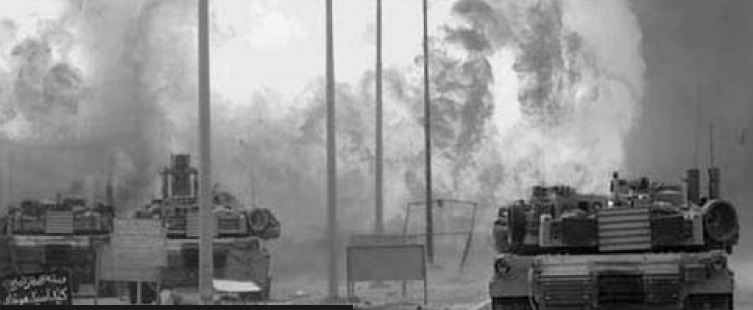
For four years, the resistance has stayed in the shadows, without a public face and apparently leaderless, while delivering a devastating campaign that has brought the world’s most powerful army to the brink of defeat and changed the balance of global power. As Al Qaeda-style suicide atrocities against civilians and Sunni-Shia sectarian death- squad killings have escalated in the past couple of years, they have tended to shift attention away from the guerrilla war against the US and British occupation forces and their client Iraqi army and police. But it is that growing guerrilla war of attrition that has pushed the demand for US withdrawal from Iraq to the top of the political agenda in Washington. There are now more than 5,000 attacks a month against US forces across Iraq. The past three months have been the bloodiest for US forces since the 2003 invasion (331 deaths and 2,029 wounded). The resistance leaders themselves estimate the movement to be 50,000-strong.
Public political face
Until now, the resistance groups have operated entirely underground and their leaders have communicated with the outside world mainly through Internet postings, if at all. Now they have decided to speak to the western press for the first time as they prepare to launch a public face and a common political programme in anticipation of eventual American and British withdrawal from Iraq. Seven of the most important Sunni-led armed organisations – excluding Al Qaeda and the Ba’athists have agreed to form a united front and have drawn up a series of demands to form the basis of future negotiations with the occupation forces.
No support
Zubeidy insists that they have no direct contact with the Syrian regime – and they do not advertise their presence in Damascus. “Our organisations depend on stores of weapons left by Saddam Hussein, or we buy them from the Iraqi army through merchants,” says Zubeidy. “We try to avoid links with the Syrians. Either they can sell us out at any time if there is heavy pressure on them, or we risk being completely controlled by them.”
All the groups say they have no support from any regime, although they acknowledge indirect contact with France about creating the conditions for a public office. A couple of years back, Zubeidy says, Iran offered the Islamic resistance groups weapons, money and help to stop attacks from the Shia militia, but while he believes Al Qaeda accepted, the others did not. “We do not trust Iran. We need help from Arab and other governments. But although Turkey and Saudi Arabia have encouraged the resistance to unite, they are afraid of us”.
Perspective on resistance
“We are the only resistance movement in modern history that has received no help or support from any other country,” Omary declares. “The reason is that we are fighting America.” “Our position is that there are two kinds of people in Iraq: not Sunni and Shia, Kurdish and Arab, Muslim and Christian, but those who are with the occupation and those who are against it.” Anyone who takes part in the institutions set up by the occupation, such as the government and parliament, army or police, are regarded as collaborators. “Our organisation began its operations in the first days after the invasion and wherever you find the occupation, you will find us: from Mosul, Baghdad and Samarra to Basra, Hillah and Kirkuk,” continues Omary. “Our group has also carried out attacks on British forces in Basra.” They are not a Sunni sectarian organisation, he insists: “The military leader of the Brigades is a Kurd. Iraq is for all Iraqis and we only distinguish between those who co-operate with the occupation and those who do not. If my brother cooperates with the occupation, I will kill him – but the innocent must not be touched.”
Why join the resistance?
“Many people come to the resistance because of their Islamic background, some because of what has happened to their relatives at the hands of the occupation armies,” says Zubeidy. “American forces have committed very big crimes against the Iraqi people. All Iraqis hate the foreign forces and won’t forget what they have done. British forces have helped the US and the British government shares the blame for everything that happened to Iraq. But their actions are less cruel than the Americans.”
Against al qaeda sectarianism
At the heart of the new insurgent alliance is a rejection of the murderous sectarianism that has come to grip Iraq – and the role of Al Qaeda in particular. Most striking is the case of Zubeidy, whose hardline salafist (purist Islamic) group Ansar al-Sunna recently split in half over the issue (his faction is now called the Legitimate Committee of Ansar al-Sunna – Goure says such splits are endemic in the resistance movement). “We wanted to unite with other resistance forces, but the other group is moving closer to Al Qaeda and refused. Al Qaeda has brought benefits and problems,” Zubeidy says. “They attack the US occupiers. But every day the problems they bring become greater than the benefits.
“Resistance isn’t just about killing Americans without any aims or goals,” he continues. “Our people have come to hate Al Qaeda, which gives the impression to the outside world that the resistance in Iraq are terrorists. Suicide bombing is not the best way to fight because it kills innocent civilians. We are against indiscriminate killing – fighting should be concentrated only on the enemy. They [Al Qaeda] believe that all Shia are kuffar [unbelievers] and most of the Sunnis as well.” They estimate that Al Qaeda now carries out between a fifth and a third of all attacks in Iraq.
But they say that it is necessary for the Sunni- based groups to ally with the Shia. “Even though that is not easy,” says Zubeidy. “A great gap has opened up between Sunni and Shia under the occupation and Al Qaeda has contributed to that as have the US and Iran. Most of Al Qaeda’s members are Iraqis but its leaders are mostly foreigners. The Americans magnify their role, even though they are responsible for a minority of resistance operations – remember that the Americans brought Al Qaeda to Iraq.”
Against civilian targets
Sectarian division has been inflamed, Omary adds, as part of the “old British imperial tactic of divide and rule”. Who benefits, asks Abu Ahmad, when there are bombs in markets? “It is only the occupying forces and Iran.” All the Sunni-led resistance groups are acutely aware of the threat posed by sectarian division to the future of Iraq and emphasise their strong links to those Shia with fewer links to Iran (what they call Arab “national” Shia). They reject any suggestion of making common cause with the Shia militia and political parties – including the anti-American Mahdi Army, which is thought to be behind many of the current armed attacks on British forces in Basra – because of their participation in the occupation’s political institutions and their role in ethnic cleansing and sectarian killings. The man who came to Zubeidy’s house last year and killed his brother-in-law after demanding a million-dollar ransom claimed to be from the Mahdi Army. While all seven of the armed groups joining the new front reject attacks on civilians, they have no qualms about brutal violence against Iraqi police and soldiers, or US and British troops
A united front
“Peaceful resistance will not end the occupation,” states Abu Ahmad. “The US has made clear that it intends to stay in Iraq for many decades. Now it is a common view in the resistance that they will start to withdraw within a year.” Right or wrong, that is one of the factors that has led to the decision to form the new front, which is planned to be called the Political Office for the Iraqi Resistance. As well as Iraqi Hamas, the 1920 Revolution
Brigades and the new Ansar al-Sunna, it is to include the powerful Jaish (army) al-Islami, Jaish al-Mujahideen, Jama’ and Jaish al-Rashideen. The plan is to hold a congress of the seven groups to announce the front’s formation and then move towards the establishment of some form of public presence outside Iraq, though it is hard to see any state being prepared to risk the wrath of the US by hosting such an outfit. “It would need UN protection,” Zubeidy suggests.
- They have already agreed that at the heart of the programme will be the following:
- A commitment to liberate Iraq from all foreign troops;
- Recognise only those who reject the occupation and its institutions as able to represent Iraq;
- Demand compensation from foreign forces for the devastation they have inflicted on the country;
- Declare all decisions taken by the occupying states and its client government null and void;
- And reject any change in population distribution.
The aim is for the front to join other independent anti-occupation forces from across the country to negotiate with the Americans for their withdrawal. A temporary technocratic government would then manage the country during a transition period until free elections could be held for a new independent government. Even Saddam’s revamped Ba’ath party – which now plays what is regarded as a reduced role in the resistance – is an enthusiast for fully competitive elections.
Resistance continues
But what if the US does not start to withdraw from Iraq next year, as the resistance groups expect, or merely withdraws to the huge military bases it has built around Iraq to intervene as and when it sees fit? “As long as foreign forces remain in Iraq,” Omary replies, “the Iraqi government will not be independent. And armed resistance will continue.”
Seumas Milner* is a journalist. Names have been changed in this article. This is an edited version of the article, syndicated from www.liveleak.com, December 2007.
Leave a Reply
You must be logged in to post a comment.