
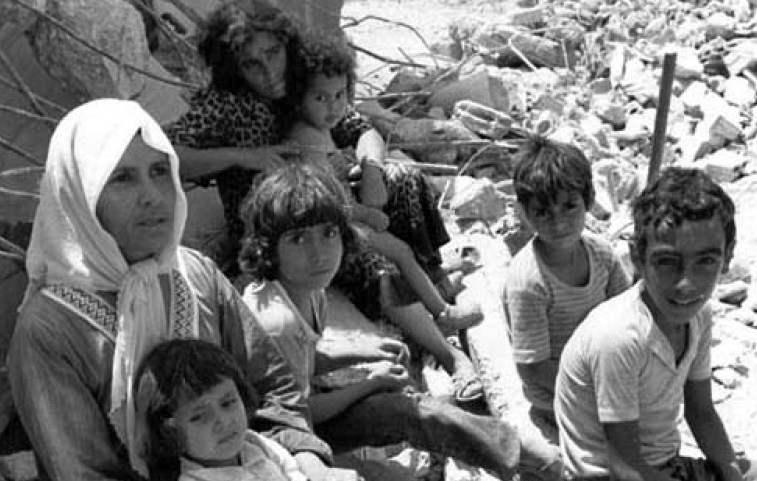
In this article Jonathan Cook highlights Israel’s role in targeting civilians during the war with Lebanon.
The Second Lebanon War that lasted a month consisted of mostly Israeli aerial bombardment of Lebanon, and rocket attacks from the Shia militia, Hezbollah, on northern Israel in response. It ended with more than 1 000 Lebanese civilians and a small but unknown number of Hezbollah fighters dead, as well as 119
Israeli soldiers and 43 civilians.
When Israel and the United States realised that Hezbollah could not be bombed into submission, they pushed a resolution, 1701, through the United Nations. The resolution placed an expanded international peacekeeping force, UNIFIL, in south Lebanon to keep Hezbollah in check and try to disarm its few thousand fighters.
But many significant developments since the war have gone unnoticed; including several that seriously put in question Israel’s account of what happened in the summer of 2006.
Hezbollah
The war began on 12 July, when Israel launched waves of air strikes on Lebanon after Hezbollah killed three soldiers and captured two more on the northern border. (A further five troops were
killed by a land mine when their tank crossed into Lebanon in hot pursuit.) Hezbollah had long been warning that it would seize soldiers if it had the chance, in an effort to push Israel into a prisoner exchange. Israel has been holding a handful of Lebanese prisoners since it withdrew from its two- decade occupation of south Lebanon in 2000.
An editorial in the liberal Israeli newspaper Haaretz said that this was “a war initiated by Israel against a relatively small guerrilla group.” There are several reasons why Haaretz may have reached this assessment.
Recent reports revealed that one of the main justifications for Hezbollah’s continued resistance – Israeli failure to withdraw fully from Lebanese territory in 2000 – is now supported by the UN. Last month its cartographers (map drawers) quietly admitted that Lebanon is right in claiming sovereignty over a small fertile area known as the Shebaa Farms, still occupied by Israel. Israel argues that the territory is Syrian and will be returned in future peace talks with Damascus, even though Syria backs Lebanon’s position. The UN’s admission has largely been ignored by the international media.
Civilian casualties
One of Israel’s main claims during the war was that it made every effort to protect Lebanese civilians from its aerial bombardments. The casualty figures suggested otherwise, and increasingly so too does other evidence. A shocking aspect of the war was Israel’s firing of at least a million cluster bombs, old munitions supplied by the US with a failure rate as high as 50 percent, in the last days of fighting. The tiny bomblets, effectively small land mines, were left littering south Lebanon after the UN-brokered ceasefire, and are reported so far to have killed 30 civilians and wounded at least another 180. Israeli commanders have admitted firing 1.2 million such bomblets, while the UN puts the figure closer to 3 million.
At the time, it looked suspiciously as if Israel had taken the brief opportunity before the war ’s end to make south Lebanon – the heartland of both the country’s Shia population and its militia, Hezbollah — uninhabitable, and to prevent the return of hundreds of thousands of Shia who had fled Israel’s earlier bombing campaigns.
Israel’s use of cluster bombs has been described as a war crime by human rights organisations.
According to the rules set by Israel’s then chief of staff, Dan Halutz, the bombs should have been used only in open and unpopulated areas – although with such a high failure rate, this would have done little to prevent later civilian casualties.
Investigation
After the war, the army ordered an investigation, mainly to satisfy Washington, which was concerned at the widely reported fact that it had supplied the munitions. The findings, which should have been published months ago, have yet to be made public. The delay is not surprising. An initial report by the army, leaked to the Israeli media, discovered that the cluster bombs had been fired killed during the war, was that Hezbollah fighters had been regularly hiding and firing rockets from among south Lebanon’s civilian population. Human rights groups found scant evidence of this.
arab communities
As a first-hand observer of the fighting from Israel’s side of the border last year, I noted on several occasions that Israel had built many of its permanent military installations, including weapons factories and army camps, and set up temporary artillery positions next to, and in some cases inside, civilian communities in the north of Israel.
Many of those communities are Arab:
Arab citizens constitute about half of Galilee’s population.
Locating military bases next to these communities was a particularly reckless act by the army as Arab towns and villages lack the public shelters and air raid warning systems available
in Jewish communities. Eighteen of the 43 Israeli civilians killed were Arab, a proportion that surprised many Israeli Jews, who assumed that they would not want to target Arab communities.
New evidence suggests strongly that, whether or not Hezbollah had the right to use its rockets, it may often have been trying to hit military targets, even if it rarely succeeded. The Arab Association for Human Rights, based in Nazareth, has been compiling a report on the Hezbollah rocket strikes against Arab communities in the north since last summer. It is not sure whether it will ever be able to publish its findings because of the military censorship laws.
The Association has looked at northern Arab communities hit by Hezbollah rockets, often repeatedly, and found that in every case there was at least one military base or artillery battery placed next to, or in a few cases inside, the community. In some communities there were several such sites. This does not prove that Hezbollah wanted only to hit military bases, of course. But it does indicate that in some cases it was clearly trying to, even if it lacked the technical resources to be sure of doing so. It also suggests that, in terms of international law, Hezbollah behaved no worse, and probably far better, than Israel during the war.
Jonathan Cook, a Journalist based in Nazareth
Leave a Reply
You must be logged in to post a comment.