
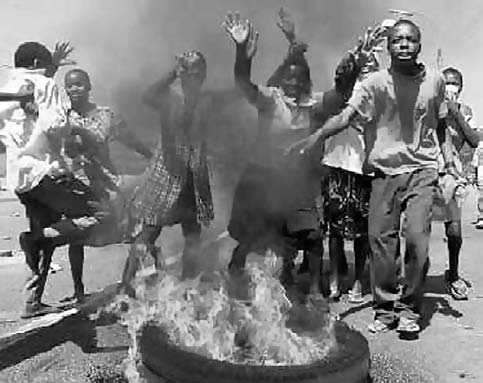
Munyaradzi Gwisai* argues that the solution to the present crisis in Zimbabwe lies in a revolution from below rather than a bourgeois deal from above.
Zimbabwe is at cross-roads as the economy rapidly heads for implosion. In June 2007 a group of 34 international NGOs in Zimbabwe warned of economic collapse within six months. Outgoing US ambassador, “regime change” specialist, Christopher Dell, went further to predict an end-game for president Mugabe in the light of the country’s accelerated economic collapse. The Reserve Bank Governor, Gideon Gono also attested to the gravity of the situation when he said that the country was facing an unprecedented abyss. In the last two weeks of massive price increases of basic goods, such predicted economic collapse seemed imminent in July 2007, prompting the government to order the slashing by 50% of prices of all goods and services and imposing a price freeze. At the burial of Brigadier General Gunda at the National Heroes Acre on the 27th June (the day when British PM Tony Blair also left office) Mugabe threatened to nationalize all business that flout the price controls and jail the owners:
“Zvatirikuuya nazvo iyezvino tavakuomeserana (what are now introducing will make it difficult or hard for everyone). Kana to tinha, touya (when we say we are coming, will be definitely coming), whether you are bakers, producers, industry or commerce, take note, tinokuteverai (we will follow up on you). Ende hausi mutambo uchaitwa zvakanaka (and its not going to be a fair game), it would be a rough game. Tavakusungana (we will be arresting everyone regardless), you will be jailed. We will not be defeated by these tactics of regime change of the British …we will seize the mines and companies. We will nationalize them if they continue with these dirty games… we will take all the companies. Tinogona kuritambawo game iroro, ende tichimwisa futi, ne rough iyoyo (we can also play that game and we always win even with brutal force (if it means that).”
The question is: is this just another toothless bark by the Mugabe regime, does it mean business this time or has the end-game indeed finally arrived?
Mugabe’s two choices
In February 2003 we predicted that the main factor that would determine the future of Zimbabwe was the worsening economic crisis and how the main political actors would respond to it. We stated then that whilst Mugabe “was an intelligent and ruthless operative, capable of sophisticated and tactical shifts and the wrong-footing of his opponents, he and ZANU–PF are not immune from the tensions arising from the economic crisis, to which they have no solution.” We stated then that the Mugabe regime had two choices: enter into a compromise deal involving a neo-liberal government of national unity of elites in ZANU-PF and MDC supported by the West with Mugabe himself retiring; or refuse to compromise politically, even as it proceeded with Gono’s neo-liberal programme and increased repression. We warned – that “the deepening of the neo-liberal agenda by a Mugabe government especially without the co-option of the MDC as a junior partner and acquiescence of the West would accelerate the economic crisis to the proportions seen in Argentina at the end of 2001 as local and international capital lay siege on the beleaguered regime…” As it were Mugabe chose the second option, especially with his decision to run again in 2008, and with it the climaxing economic crisis we see today. But does that mean he is finished?
Mugabe not finished
The imperialists have probably spoken too prematurely. Although in a corner the regime can still wiggle out by whipping business into line. Or alternatively tenaciously cling on to power precipitating such economic and political upheavals that could lead to complete social disintegration including a failed state.
Despite the threats Mugabe is unlikely to want to nationalize, fearful of further accelerating the crisis, and that in any case his government is after all predominantly made up of bosses. But if business resists, as it has immediately done now by taking goods off the shelves, more radical measures are likely to follow. These may include a combination of partial nationalization, seizing some foreign businesses to give to his cronies under the guise of indigenisation or letting out ZANU PF hordes into selected shops, jailing some bosses and introducing a new currency. Already nearly 5 000 business executives have been reportedly arrested with a few jailed for some days, including some from blue chip stock exchange companies like Meikles Africa and OK Supermarkets. Mugabe counts on the fact that business is likely to play ball being afraid of a repeat of the farm invasions and knowledge that he has the necessary two thirds parliament majority to amend the constitution. Already there are reports that the top captains of industry and commerce had a special meting with Mugabe at the end of July 2007 in which they have indicated their willingness to work with the government in addressing the crisis arising out of the price increases. If Mugabe had not taken the above measures, there was a real danger of the crisis escalating into massive political threat to his regime.
But given the depth of the crisis and the regime’s lack of control over basic levers of the economy, such measures on their own might still not be enough. The capitalists will still indirectly sabotage the measures by cutting down production citing lack of foreign currency and fuel. This is already happening and has created serious shortages of most basic goods as well as empty supermarket shelves, thus threatening instability. Beside these measures, Mugabe requires a conducive political environment. This is why the regime accepted the Social Contract with labour and business as a way of pre-empting labour unrest and mass stayaways. Although the last work stayaway was not particularly successful, the regime is aware that in the context of a growing economic crisis, future ones may be. So Mugabe is counting on the labour leaders marshalling and controlling the working class from rising up against worsening living conditions. Unfortunately there is a right- wing donor-funded element in the ZCTU which is comfortable with this, and unless resisted will attempt to stifle any serious mass action from labour.
The second front Mugabe is worried about is the MDC, especially the Tsvangirai faction, which still has significant support amongst the urban poor. He will therefore hope that the MDC will not be tempted to go back to the streets again along with civic society and labour. The potential of such action is high, especially if Mugabe’s economic measures fail. So the regime has been using the SADC – Mbeki talks to buy time, using all sorts of delaying tactics including non-appearances, to extend them as close to next year as possible. The idea is to focus the MDC on elections next year rather than taking advantage of the current situation to push for mass action. Thus the crisis of leadership and unwillingness to fight in the opposition and labour movement is a key factor in the continued survival of the Mugabe dictatorship. Yet the regime also knows that the crisis is far too deep for it to continue without reaching some kind of compromise with the west and the opposition.
Contrary to popular belief, Mugabe himself is not totally averse to some kind of elitist compromise deal. His retention of the neo-liberal Gono and his doling out of tractors to MDC leaders shows that he too is ready to compromise, but in a deal that leaves him and his party as the senior partners. Already reports indicate that he is ready for a neo-liberal economic deal backed by SADC and the West, but only after the elections.
Struggle the only way forward
So whilst the economic crisis in Zimbabwe is climaxing it is naïve to think it will lead to automatic regime change or election victory in March 2008. As we previously stated:
“It is not all that obvious which way Zimbabwe will go or that the bourgeois elites will have their way.
The country is at unprecedented crossroads, a virtual precipice…It is quite possible that if the local elites fail to urgently strike a settlement …including the
resolution of the Mugabe succession issue, Zimbabwe could easily go the way of the growing number of neo- colonial failed states, notably Cote D’Ivoire…”
Another possible response to the crisis is that the working class could again, as it did in 1996 – 98, inspire the rest of the people and sections of the middle classes into massive social and political struggles against the entire neo-colonial and neo liberal capitalist state as we see happening in the anti-capitalist struggles in Latin America today.
But such struggles require that the working class build appropriate organizations to lead the struggle and develop an independent revolutionary socialist class ideology that guides them to victory. Critical to this, is the transformation of trade unions into more democratic, united and accountable organs of workers and the building of a political united democratic front of all progressive sections of the working people, urban and rural, with clear class and ideological lines, unlike the broad-based alliance dominated by the bourgeoisie of 1999… The worsening economic situation will continue to trigger small to significant revolts centred around bread and butter issues … The challenge is to generalize and link such different small actions into broader, bigger and specific campaigns supported by all the various forces still ready to fight, whilst also linking these to the struggle for a new democratic and anti-capitalist constitution…In the immediate, the objectives of such struggles would include complete constitutional reform to expand democracy, legal institutions, nationalization of the commanding heights of the economy, land re distribution and general subordination of private property to society’s needs. A central demand of the movement must be that harmonized elections be done by 2008 but only under a democratic, people driven and anti-ESAP constitution. If the regime rejects this … then the struggle must be shifted to all out mass action – jambanja or civil disobedience…a determined struggle to throw it out. This must be the basis on which co-operation with the opposition parties must be built, but on the basis of an autonomous movement of working people and other radicals, so that when the political parties betray the struggle by entering deals with the dictatorship, as they are likely to, the struggle will continue…”
Thus whilst this struggle should include the main opposition MDC, it would be a huge mistake to surrender leadership of the action to it, for as we have argued before – “… any strategy of fighting the dictatorship based on a movement dominated or controlled by the MDC (like the Save Zimbabwe Campaign) will remain prisoner to the glaring ideological and strategic confusion it has shown since 2000 and is bound to fail… Even if it should engage in some mass action …its primary pre occupation is towards reaching a sell out settlement with the ZANU-PF dictatorship that will not benefit the poor and working people… In other words to quote ZCTU president Lovemore Matombo:
‘our goals are different. We see the product of this process as social revolution. They don’t.”
Leave a Reply
You must be logged in to post a comment.