
Final Statement from WSF Assembly of Social Movements wsf 2007 assembly of social movements
FINAL CALL: African Struggles, Global Struggles
We, social movements from across Africa and across the world, have come together here in Nairobi at the 2007 world social Forum to highlight and celebrate Africa and her social movements; Africa and her unbroken history of struggle against foreign domination, colonialism and neo-colonialism; Africa and her contributions to humanity; Africa and her role in the quest for another world.
We are here to celebrate and reaffirm the spirit of the World Social Forum as a space of struggle and solidarity which is open to all people and social movements regardless of their ability to pay.
We denounce tendencies towards commercialisation, privatization and militarization of the WSF space. Hundreds of our sisters and brothers who welcomed us to Nairobi have been excluded because of high costs of participation.
We are also deeply concerned about the presence of organisations working against the rights of women, marginalised people, and against sexual rights and diversity, in contradiction to the WSF Charter of Principles.
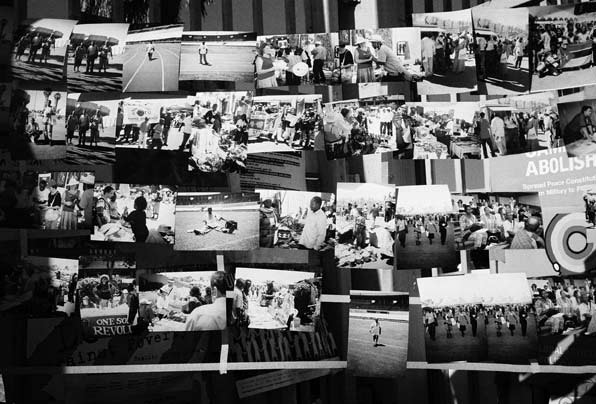
The social movements assembly has created a platform for Kenyans and other Africans from different backgrounds and communities to present their struggles, alternatives, cultures, talents and skills. It is also a space for civil society organizations and social movements to interact and share the issues and problems affecxting them.
Since the first assembly in 2001, we have contributed to building and strengthening successful international networks of civil societies and social movements and reinforced our spirit of solidarity and our struggles against all forms of oppression and domination.
We recognize that the diversity of movements and popular initiatives against neo-liberalism, world hegemony of capitalism and imperial wars, is an expression of world resistance.
We have now to move towards a phase of effective alternatives. Many local initiatives already exist and should be expanded: what is happening in Latin America and other parts of the world ˆ thanks to the joint action of social movements ˆ shows the way to establish concrete alternatives to world capitalist domination.
As social movements from all five continents gathering in Nairobi, we express our solidarity with the social movements in Latin America whose persistent and continuing struggle has led to electoral victories for the Left in several countries.
Actions
we are calling for a broad international mobilization against the g8 in rostock and heiligendamm (germany)
2-8 June 2007.
we will mobilize in our communities and movements for an international day of action in 2008. nairobi, January 24th, 2007.
GLOBAL CALL TO PROTEST THE
4TH ANNIVERSARY OF THE U.S. INVASION & OCCUPATION OF IRAQ
Adopted in the anti war assembly, world social forum, January 24, nairobi Kenya
stop the war and bring all the troops home!
No Control of Iraq Oil!
Close all the U.S. bases in Iraq !
Compensation and Justice for Iraqi victims and detainees!
Stop the regional wars!
End the Israeli Occupation of Palestine !
Strengthen boycotts, sanctions, and divestments against Israeli occupation! Stop the threats to Iran !
Troops out of Afghanistan ! Stop bombing Somalia !
Stop US support for warlords and other US backed surrogates in Africa ! Support for peaceful resolution to Darfur crisis! No
military intervention!
Stop violations of civil liberties and human rights in the name of anti-terrorism!
Calendar of actIons:
BOOK REVIEW
Triumph and tragedy of a
South African Communist: Ray
Alexander Simons, 1914-2004
Lucien van der Walt* looks at the life of one
Despite her backbreaking political work, Alexander was married twice and raised three children. Her autobiography makes it clear what sacrifices and pain her political commitments could entail. She had the support of a very tender marriage with Jack Simons – a radical lecturer at the University of Cape Town – that lasted 54 years, and ended with Simons’ death in 1995. In exile, she continued her activism, largely through overseas SACTU structures (the federation was defunct in South Africa), the SACP journal The African Communist, and ILO conferences (Alexander 2004:
309-320, 329-331, 333-4).
Ray Alexander ’s contribution was enormous, and she has been almost canonised since her death. However, this was a contribution shaped colonial and semi-colonial world, it called for the establishment of “An Independent South African Native Republic as a stage towards the Workers’ and Peasants’ Republic, guaranteeing protection and equality to all national minorities.”
This formulation effectively removed socialism from the agenda of the CPSA and SACPand fostered an orientation towards African nationalism. It substituted a politics of multi-class, race-based struggle for a reformed capitalist State for an older revolutionary syndicalist (and early CPSA) perspective of a class-based struggle against both national oppression and against capitalism.
The eventual outcome was the transformation of the Party from an independent popular force into an ANC auxiliary. In Class and Colour this of the veterans of the South African anti- apartheid struggles ray alexander simons, 2004, All my Life and All my Strength, stE Publishers, Johannesburg, 378 pages, soft cover, edited by raymond suttner, with introduction by Iris berger, Isbn: 1-919855-12-2, zar 160.00.
All my Life and All my Strength is the autobiography of Ray Alexander Simons, the South African Communist Party (SACP) and African National Congress (ANC) veteran who died at 90 in 2004. She was lauded as “a hero of the working class” by the Congress of South African Trade Unions (COSATU), and recently received the African National Congress’ highest honour, the Isithwalandwe. Edited for publication by Raymond Suttner, the book provides a mass of detail about the inner workings of the Party and local left-wing trade unions from the 1920s to the 1960s, as well as some insight into the period of ANC and Party exile politics starting in the 1960s.
It also inadvertently highlights the limitations of the politics of the SACP, a Party which shaped a generation of South African socialists. The autobiography is a testament to the sacrifices and dedication of an earlier generation, but indicates some of the blind spots and contradictions of local socialist traditions.
Born in Latvia in 1914, as Rachel Esther Alexandrowitch, Ray Alexander was active in Latvia’s underground Communist movement in her teens. She left for South Africa in 1929 at the age of 15: the exact reasons for the family’s decision to begin emigrating from 1927 onwards are not very clear, but the oppressive atmosphere of anti- Semitism and political repression played a role (Alexander, 2004: 28-31, 38-44). Her decision was a fortunate one, for Latvia became a fascist state in 1934, while the Nazi occupation of 1941-1944 led to large-scale massacres of Jews, including the murder of Alexander ’s two half-sisters and their families (Alexander 2004: 306-8).
Whether in Latvia or in South Africa, Alexander was, first and foremost, powerfully and emotionally attached to the official Communist cause: soon after her arrival in Cape Town, she “cried the whole night” after hearing (mistakenly, it turned out) that there would be no local commemoration of the Russian Revolution (Alexander 2004: 50). Active in the SACP, and its predecessor, the Communist Party of South Africa (CPSA), formed in 1921, Alexander left South Africa for exile in the 1960s, returning in 1990 when the apartheid struggle was coming to a negotiated end.
There is no doubt that the experience of anti- Semitism in Latvia played a key role in Alexander ’s powerful commitment to non-racialism in South Africa. One of a small group of radical Whites who rejected apartheid, she would come up against the pervasive racial prejudices of Whites and Africans alike throughout her life (Alexander 2004: 54, 62, 77, 80, 146, 158, 177-8, 310, 317, 328). Having decided to get involved in trade union work within two days of her arrival, she joined the local Communist Party the very same week (Alexander 2004: 50-52).
Trade unionism occupied Ray Alexander most until her exile in 1965, and the autobiography provides a uniquely vivid insight into the union movement of this period (Alexander 2004: pp. 70-171). She was involved in a wide range of unions, usually amongst African and Coloured workers, and was the leading figure in the Food and Canning Workers Union, founded in 1941. The Food and Canning Workers Union was later part of the multiracial SA Congress of Trade Unions (SACTU), which was linked to the underground SACP and the ANC from its inception in 1955. by an unswerving loyalty to the Soviet Union and official Communism. It is too easy to say, as Iris Berger does in the introduction, that Alexander ’s Communism was “intrinsically tied to her East European Jewish heritage” (Alexander 2004: 7). Few local Jewish immigrants joined the SACP, and even fewer showed the same lifelong loyalty as she did – a loyalty unbroken by the SACP crises and purges in the 1920s and 1930s, Stalin’s purges in the Soviet Union, the Soviet invasion of her homeland, Latvia, in 1939, the dissolution of the Comintern in 1943, the subsequent Soviet colonisation of East Europe, and the collapse of the Soviet bloc from 1989 onwards.
One of Ray Alexander ’s major political roles–barely touched in the autobiography – was as a key member of a select group of leading SACP intellectuals that defined Party strategy and thinking. Most importantly, she wrote the definitive pro-Party version of struggle history in South Africa: the 1969 Class and Colour in South Africa, 1850-1950, co-authored with her husband Jack Simons.
This is the central text in a whole “Communist school” of local socialist history writing, a school that has been immensely influential in shaping scholarly and popular perceptions of the history of the local left. The key feature of this school’s narrative has been to structure the whole history of local socialism around the supposedly triumphant onward march of the Party, with traditions that preceded or operated alongside the CPSA/SACP, like anarchism and syndicalism, ignored or caricatured.
Ray Alexander ’s views on the national question in South Africa were shaped by the CPSA’s adoption in 1928 of an immensely controversial two-stage “Native Republic” approach, largely imposed by the Comintern: in line with similar policies imposed on Parties throughout the is defended uncritically: “the class struggle had merged with the struggle for national liberation” (Jack and Ray Simons [1969] 1983: 609). The possibility that “national liberation” could mean more than a capitalist “Native Republic,” or that “the class struggle” could mean more than workplace struggles, or even that the CPSA/ SACP could itself be the agent of “national liberation” disappeared, and opposing views were dismissed as sectarian or racist. It is this blind faith in the ANC that led the exiled SACTU to label independent African unions outside that formation as puppets of a “fascist” State (an inglorious period absent from All my Life reminiscences of SACTU).
The late 1920s also saw the CPSA enter its worst crisis, a “very painful period” (Alexander 2004: 73). Lazar Bach (another Latvian émigré) was a key figure in a series of purges inspired by the New Line stress on “Bolshevising” the Party: many key members were expelled (some later reinstated), including founders like Bill Andrews, trade unionists like Solly Sachs, and African leaders like Gana Makabeni.
Ray Alexander casts some new light on this period, having previously known (and disliked) Bach in the Latvia underground, a dislike reinforced by his supposed sexual harassment (Alexander 2004: 43-4, 59, 63-4). However, in Ray Alexander ’s account, the devastating Party purges of the early 1930s are presented largely as the outcome of Bach’s personal flaws, rather than Comintern policy and the growing use of Parties for Soviet foreign policy.
The same defence of Comintern actions may also be found in Class and Colour, where the widely unpopular imposition of the Native Republic line (a variant of the general two-stage strategy for colonial and semi-colonial countries) is presented as historically necessary and as the initiative of South African Communists (see Jack and Ray Simons [1969] 1983: 388-393).
Such apologias for the Comintern are consistent with Ray Alexander ’s blind spot for the Soviet bloc, as well as the self-described “progressive” and “anti-imperialist” regimes linked to that bloc. In 1929, for instance, she called for the “right of all women to vote, as in Russia” (Alexander 2004: 59), although the basic civil liberties had been suppressed by Bolshevik crackdowns since 1918. The 1939 Soviet conquest of Latvia was euphemised as its “attachment” (Alexander 2004: 306), rather than recognised as an example of imperial conquest similar to that which created “South Africa.”
Without irony, too, Ray Alexander could recall “congratulatory telegrams from new democratic states such as Hungary, Bulgaria, Romania, [and] East Germany” being presented at Andrews’ 80th birthday (Alexander 2004: 206): her struggle for democracy in South Africa existed alongside uncritical support for these regimes. This sort of political schizophrenia – authoritarianism was acceptable if draped in left colours – was typical of a generation of South African socialists.
Despite close contacts with the Soviet bloc in exile, including several visits, it was only in the mid-1980s that Ray Alexander discovered some problems in the “state of affairs” in the Eastern regimes, which “upset me terribly” (Alexander 2004: 334). In 1990 she was shocked to learn that Moscow bus workers had just struck for a cloakroom – “our workers in Cape Town struck and won it in 1932,” and seems to have finally realised that she had only been to “posh” hotels and never the “homes of the people” in the Soviet bloc countries (Alexander 2004: 339). Such revelations did not shift Ray’s politics, and she was devastated by the subsequent collapse of the bloc (Alexander 2004: 338-340). She never considered that these regimes might have been something other than they claimed (like an ensemble of State-capitalist dictatorships), or supported the anti-apartheid struggle for primarily geo-strategic reasons.
The contradiction within Alexander ’s thinking – between supporting democratic and popular struggles within South Africa, and supporting a brutal Soviet regime and its client States – is at the heart of her political tragedy. In 1970, for example, Alexander attended the ILO on behalf of SACTU to “expose South African legislation,” described as uniquely repressive (Alexander 2004: 311). Yet the “anti-imperialist regimes” of Africa and the Soviet bloc that supported the resolution (and SACTU resolutions more generally), typically used State-run unions to discipline the working class to foster local capital accumulation; their authoritarian industrial relations systems were not so very different to those of South Africa (Alexander pp. 184-5).
A fearless activist, she was crippled by a conceptualisation of socialism that embraced the Soviet system; a champion of working class struggles in South Africa, she shared platforms with some of the twentieth century’s most venal dictators.
And this tragedy is not that of Ray Alexander alone. A whole generation of the South African left – and the left elsewhere – was willing to envisage socialism as a system neither created nor controlled by the working class, and to support any oppressive regime that draped itself in red flags or “anti- imperialist” rhetoric. Socialism was stripped of its democratic content, and became identified with central planning, one Party regimes, and military parades in the Red Square, while internationalism came to mean support for one bloc of States against another.
If socialism is to have a future, it must be libertarian, committed to an independent, internationalist and self-managed working class politics: the contemporary left must rescue socialism from authoritarianism, vanguardism and nationalism.
This is what we can all learn from Ray Alexander, from her triumphs, and from her tragedy.
References
Jack and Ray Simons, [1969] 1983, Class and Colour in South Africa, 1850-1950, International Defence and Aid Fund, London
Leave a Reply
You must be logged in to post a comment.