
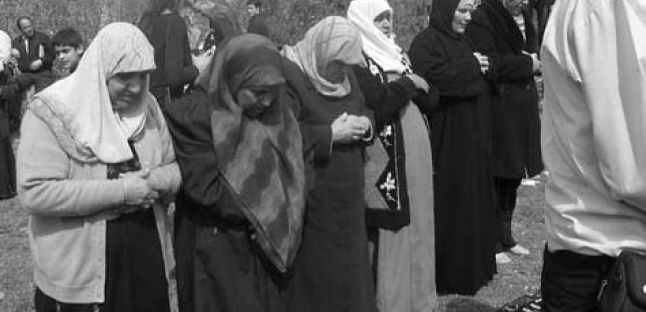
Islah Jad* discusses women in the context of the struggles in Palestine and argues that many different images of women co-exist in Palestine today.
The signing of the Oslo Agreement in 1993 led to the formation of the Palestinian Authority (PA) which started to function in many ways as a state in Occupied Palestine. However, this ‘state’ did not have a clearly defined territory, nor did it have supreme power within its territory: the occupying power, Israel, had, and still has power.
Contextualising women’s rights
The call for women’s rights in a situation where the state does not exist in legal or political terms might lead women to limit themselves to a narrow definition of rights, while their states and societies are falling apart. This might lead to a greater sidelining of women’s rights and demands.
The post-colonial states in the Arab world introduced specific policies to address women’s rights: policies to increase women’s employment and education; control of women’s fertility, and the provision of social services. These contributed to modernisation and led to changes in gender relations. However, women’s introduction into the labour market did not produce any real change in the sexual division of labour.
Women were still expected to conform to the ideal of being both modern citizens and those who maintain cultural values and traditions. This contradiction was clearly seen in most national constitutions in which women were defined as equal citizens but with fewer rights than men.
This is not surprising because the family remained governed by shari’a law, which defines women as dependants. This dependent image is not related to the shari’a interpretation alone but to many cultural, social, economic and political factors that do not prioritise equal gender relations. Women’s rights and shari’a law became part of a dominant debate in the Middle East, including Palestine, with the change of American policy in the region after the terrorist attack on 11th September 2002.
The ideal woman
The ‘ideal woman’ varies according to the national project for modernisation of each new state. Veiled/unveiled, working woman/housewife, fighter/caretaker all represent different national visions in which women’s role and image is essential. Feminists have discussed the concept of the national ideal critically with reference to the public/private distinction, the deprivation of women’s rights, or discrimination against women in general. It is in the name of the ‘nation’
National unity is used to justify and defend the postponement of the solution of women’s problems. Priority is thus given again and again to other problems and excludes both popular demands and women’s claim for a better status in society. The time for women’s demands is never now.
Palestinian Movement
Historically, the Palestinian national movement described women either as the struggling militant or as the self-sacrificing mother. In the face of death, uprooting, rejection and annihilation, many Palestinian poets glorified the woman with a large number of children, especially male children. However, national slogans like ‘the right of return’ and ‘struggle’ required a different model for women. The woman ‘freedom fighter ’ with a gun in her hand was an image promoted by different Palestinian factions, especially on the left.
The Palestinian authority
One of the roles for women during the national struggle was as a guerrilla fighter. With the establishment of the Palestinian Authority, militarism became the domain of males and women had no place there anymore
Feminists have paid attention to militarism and its negative impact on women and gender relations. Militarism excludes women from war because
of their physical inferiority and because of their
‘qualities of peacefulness and nurturing’. Jackie Cock, an activist, argues, “Dividing the protector from the protected, defender from the defended, is the key element of masculinity as well as military ideology”.
The PA security apparatuses employ 45% of all people hired in the public sector and are allocated over one third of the total public budget. This means that women’s exclusion denies them access to the largest pool of potential jobs.
different identities
As the Israeli-Palestinian conflict has worsened and Israel has separated Palestinian communities from one another by hundreds of checkpoints and separation walls, the goal of a unified Palestinian national identity has been overtaken by the reality of local identities surrounding the ruling party (Fatah), Islamists or clan and kin loyalties. These localised identities have also affected women. For example, being close to Fatah or having family members active in Fatah, before Hamas’ 2006 election victory would have influenced the kind and size of privileges gained. The same could be said of Hamas where being active supporters of Hamas would provide access to some important services and financial aid.
The PA has promoted the ideal woman as fertile, self-sacrificing and steadfast, which resulted in contradictions. In the national struggle, the fertile woman was viewed as necessary because the conflict partly rested on the population balance between Jews and Arabs. Mothers who lost their children, especially sons, were glorified in the poetry of Palestinian poet Mahmoud Darwish. When the passive role of the wailing mother,
the giving mother, who always provides for the resistance against Israel is glorified in this way, it may not be noticed that the overwhelming Israeli violence and oppression made men equally passive and helpless.
Mothers, sisters and daughters of those killed in the fight against Israel also got conflicting messages. They were glorified and their personal suffering uplifted into national defiance and resistance; at the same time, feminist teachings urged women to be themselves to express their ‘true’ feelings and grief. Meanwhile, the Israeli propaganda promoted the idea of them being ‘abnormal’, and ‘less than real, mothers willing to secrifise their own children. This Israeli version countered the Palestinian glorification of motherhood with a demonisation of Palestinian mothers, their dead children and Palestinians in general.
Different images co-exist
With all these conflicting visions and ideals, how may one characterise the ‘new woman’ in the PA national project? The images for the ‘new women’ did not emerge from the formal policies of the PA but rather from the different forms of activism they engaged in. The Islamist groups portrayed a ‘model woman’, as in the past, as modest, patient, and a pious caretaker of her husband and children with a modest veil. She was, most importantly, the bearer of male children sacrificed in order to continue the resistance; in short the woman is the ‘giver ’. In contrast, feminist women’s activism presented a new image for women as urban, professional, elegant, claiming her individual rights from the PA, society and her family, in summary the woman as ‘taker ’. All these images of women co-exist in the Palestine of today.
* IslahJad is a lecturer in Political Science, Department of Philosophy and Cultural Studies at Birzeit University in Ramallah, in the West Bank.
Leave a Reply
You must be logged in to post a comment.