
In this article Mondli hlatshwayo* reflects on the development of the social movements in South Africa since the late 1990s, and he also looks at the challenges facing these new social justice movements.
It is well-known that the movement against apartheid and capitalism inspired many people struggling against social and economic injustices in Africa and the rest of the world. The ushering in of a democratically elected government in 1994 redefined the political landscape in South Africa. Many leaders of the anti-apartheid movement became government leaders and business people. The mass movement, which had brought down the apartheid regime, declined. Concurrently the democratically elected government implemented neoliberal policies, which led to the deepening of poverty and misery among the toiling masses of South Africa. The reality of the political situation in South Africa is that the process of rebuilding a movement against social injustice is at its infant stage.
The convergence of social movements under the banner of the SMI
By the end of the 1990s, however, new movements of resistance against the neoliberal policies of the ANC government had began to emerge. Many of them emerged in struggles against the privatisation of water, electricity and other social services.
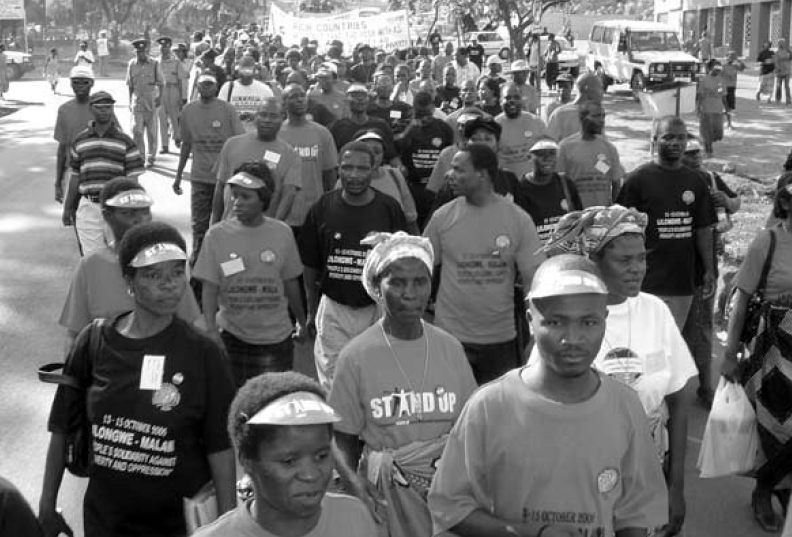
In 2001 social movements participated in the march against the United Nations Racism Conference. In 2002 the anti-WSSD march, which represented a more pronounced action of social movements was the landmark in the history of social movement cooperation. The march was a success because of a long process of engagements, discussions and debates, among the social movements. This cooperation among the movements led to the formation of the Social Movements Indaba (SMI). The SMI was a product of struggles, which brought these movements together. In particular, it was the struggles waged against attempts to use the “civil society forum” of the WSSD as a platform to support the South African government’s neoliberal agenda which led to the coming together of the movements that were to form the SMI.
The formation of the SMI – one of the key actors in the 2002 anti-WSSD march – represented indisputably an important milestone in South Africa’s post- apartheid history. A new mass movement came into existence. In an historic display of mass opposition to the neo-liberal agenda of the World Summit on Sustainable Development (WSSD), over 20 000 people marched from the impoverished Alexandra township to affluent Sandton. Under the banner of the Social Movements United (SMU) the largest ever post- 1994 mass march was staged outside the traditional Congress-aligned Alliance. The SMU was made up of the Social Movements Indaba (SMI), the Landless People’s Movement (LPM), Via Campesina and many other organisations and movements.
Social Movements in the Post-WSSd period
Subsequent to the anti-WSSD march the first annual meeting of the SMI was convened in Johannesburg in 2003. Attended by organisations that were part of the march, the meeting had to assesses mass mobilisation during the WSSD, as well as examine the path for social movement building in the post- WSSD era. Despite some debates on the role of the SMI, there was an agreement on the importance of creating a space that brings social movements together. The space was meant to evolve and include planning of common action and struggle. One of the principles that was adopted is the autonomy of each organisation taking part in the SMI. In 2004 social movements faced a mammoth challenge because of the national elections. Prior to the national elections some movements argued for boycotting the elections. Others left it to their affiliates members to decide what to do on the day of elections. Some argued for the spoiling
of the ballot as a symbol of protest against the neoliberalism of the ANC. In that year the national meeting of the SMI reflected on struggles and the fact that the national elections were confronting the movement.
The quandary was that social movements at the national meeting were unable to craft a path, which could find common ground and action around different positions on elections. This was an indication that the post-WSSD regression was
beginning to register. The significance of this failure to craft a common position becomes evident when one considers the fact that there was indeed very little that separated the positions of the different movements on the elections.
In 2005 we saw a drastic reduction of social movement visibility. Some comrades began to talk about a stasis or an interregnum. One of the indicators of this interregnum was the fact that movements in various parts of the country were
unable to make a concrete link with a chain of new struggles that broke out in communities around the country. The key struggles of this period were struggles in Diepsloot, in Gauteng, and struggles in Harrismith, Free State.
Prior to the local government elections a number of uprisings also broke out in other parts of the country. New movements taking up local issues such as water, housing, electricity and demarcation of municipal borders erupted in Khutsong, Matatiele, Durban, Mpumalanga and Cape Town.
Was happening to the movement organised under the banner of the SMI during this period of new struggles? What of other movements outside the SMI which emerged prior to the WSSD? What we can say is that the SMI and similar movements were facing serious political and organisational problems.
In a number of instances the “hype” that was generated by the WCAR and the WSSD, and the availability of resources from NGOs led to the manufacturing of national structures. The collapse of these NGOs also led to the fracturing of these national structures.
Some organisations were caught up in their domestic organisational problems. One is not arguing that the internal functioning of organisations is not important but we have to
say that it is the art of organisational politics that enables organisations to confront their internal challenges without neglecting general struggle. In other words, the pre-WSSD movements were
unable to weave the links with the “spontaneous” uprisings in Khutsong, Free State and other parts of the country.
Creating spaces for the convergence of the SMI and the ‘new’ movements of struggle
How did the annual national meeting of the SMI in 2005 deal with the asymmetry that existed between the SMI and the ‘new’ movements of struggle? The SMI acknowledged that the movements that were part of the WSSD were weak. It then suggested that the bringing in of the new organisations could be one of the solutions for addressing the weaknesses and broadening the movement.
Based on a need to link up the pre-WSSD movement and the new uprisings, organisations such as Abahlali, movements from Free State and the Western Cape were invited to the SMI national meeting in 2005.
Since the national meeting of 2005 there has been concrete evidence demonstrating the fact that social movements in the Western Cape, KZN, and Gauteng have attempted to work closely with the movements that emerged in the post-WSSD period.
The Fourth Annual National Meeting of the SMI and Tasks for Social Movements In December 2006 the fourth annual national meeting of the SMI was held for the first time in Durban. Attended by more than 150 delegates from the SMI and allied movements, the national meeting discussed the state of mobilisation in the country as well as preparations for the WSF in Nairobi. Due to time constraints, the national meeting did not discuss the questions of strategy and tasks facing the social movements. This limitation notwithstanding, the meeting dealt with a number of issues that are important for the development of the movements in the coming period:
- The meeting agreed to use the SMI platform of struggle as a tool for coordinating and building resistance. Here the national meeting resolved to use the Human Rights Day (21 March 2007)
as a national day for the right to HIV Treatment, housing, land, water, electricity and all social services and social security.
- While women have been leading struggles of social movements this has not been translated into women leadership of social movements. To address this question, women comrades held
a number of closed discussions at the national meeting. The plenary session of the meeting agreed to adopt 9 August 2007 (the national women’s day) as a day of highlighting an urgent need for women’s emancipation within the
social movements and society in general.
- The report of the secretary noted that some movements had experienced divisions and splits. On 3 December 2006, the national meet-
ing was disrupted by a group from Abahlali and the Anti-Evictions Campaign. The reasons for
the disruption ranged from accusing the SMI as being NGO-dominated to being ineffective. The fact of the matter is that the group which occupied the meeting had been provided with a platform to raise their concerns but chose a
violent and intimidatory method. The SMI del- egates took a unanimous decision to condemn the use of violence and intimidation as a no-go area within working class organisations.
- Social movements also agree to use the coming WSF in Kenya as a space for building the local organisations as well as making long lasting links with Kenyan and African organisations.
*Mondli Hlatshwayo works for Khanya College and is the Secretary of the SMI.
Leave a Reply
You must be logged in to post a comment.