
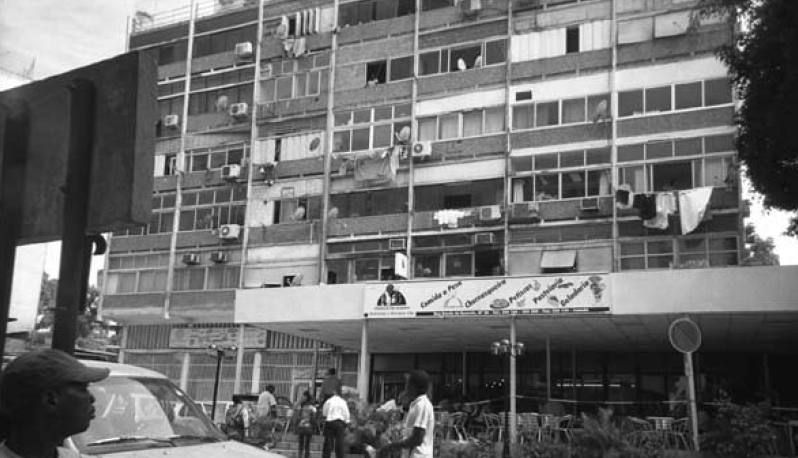
In this article Mondli hlatshwayo* looks at instances of forced evictions in luanda, Angola, human rights abuses, and at initiatives to build movements of resistance in that Country.
Addressing the basic needs of communities in terms of capacity building and information sharing. Developmental NGOs are also working with communities in conducting capacity building for some community based organisation. Labour organisations which are the Swaziland Federation of Trade Unions (SFTU) and Swaziland Federation of Labour (SFL) and as well as the Swaziland National Association of Teachers (SNAT), are working hard to educate workers about their rights, even though more education
has to be focused on trying to understand and find alternatives to these neo-liberal policies. This education is important in building a strong workers movement in so far as social movements activities are concern.
There is an organisation that seeks to organise all networks dealing with economic injustices known as the Swaziland Economic Justice Network (SEJN).
background to the socio-political situation in Angola
Angola became independent from the Portuguese in 1975 after a costly and long liberation war. For 27 years following liberation from Portuguese rule Angola was engulfed by continuous civil war between Uniao Nacional para a Independencia total de Angola (UNITA) rebels, and the governing Movement
for the Liberation of Angola (MPLA). The former were US and apartheid South Africa-backed, with the rhetoric of representing the poor ‘real’ rural Africans of the interior. On the other hand, the social base for the governing party was based on the urban elite, with a commitment to nationalism, socialism, and anti-imperialism in a conflict overlaid by the Cold War.
The Angolan state was also affected by the fall of the “Soviet bloc” and the end of the cold war in the late 1980s and early 1990s. In 1991 the state changed from a “socialist” economy to a supposed multiparty democratic state and market economy. Few freedoms were realised although free and fair elections were won by the government in 1992.
The state remained heavily centralised with the president able to control extra-budgetary revenues for his own accumulation and clientilist purposes. Angola has massive oil production. Much of the infrastructure, agriculture and rudimentary health services were destroyed by war with millions of landmines being laid – with knock-on effects on agriculture, transport as well as people’s lives. Besides deaths, war also meant displacement and urbanisation with about half of all Angolans, living in cities and towns. The agrarian system collapsed as did the health and education services
– only 37 percent of primary-aged children were enrolled in school whilst most of the health budget goes to hospital-based curative services, including elite spending in South Africa and Portugal.
Peace came in April 2002 when Savimbi was killed, leaving the MPLA-controlled government the undisputed victor. Human rights activists have raised concerns about the fact that elections have not been held in that country since the end of the war in 2002. Many NGOs and activists have raised concerns about the lack of freedom of expression and human rights in Angola. Commercial tycoons and army officers control trade and services and are able to accumulate resources by using special powers, granted to them by senior politicians, to import goods. This has led to massive corruption, and Angola is ranked 133 out of 145 countries on Transparency International’s corruption index. Between 1997 and 2001, $8.45 billion of public money was unaccounted for (an average of 23% of GDP) – IMF).
Struggles Against Forced Evictions
Forced evictions are a source of major social struggles in Angola. They affect tens of thousands of people in the capital, Luanda alone. Since July
2001, thousands of families in Luanda have been forcibly evicted from their homes, which were then demolished. They had their property either destroyed or stolen by those carrying out the
evictions. The evictions were arbitrary and carried out violently without an eviction order. Those evicted were not consulted prior to the evictions. They were not provided with alternative adequate accommodation and were not compensated for their losses. Only a few of the families evicted in
2001 and 2003 were promptly given alternative accommodation. The vast majority are left to fend for themselves. Hundreds of families evicted since July 2005, are still without shelter after repeatedly being evicted from their homes. Forced evictions almost invariably affect the poorest and most vulnerable members of society. They increase social inequality and poverty, and they frequently give rise to social conflict.
Since July 2005 the forced evictions have occurred in a number of neighbourhoods in Luanda. Examples of some of these evictions include:
Bairro Cidadania, Viana municipality, where 314 families were forcibly evicted and had their property destroyed on 26 and 27 September 2005 by municipal fiscal agents and police armed with guns and AKM rifles. The police beat those who tried to protect their homes and resisted the evictions. Two people were briefly detained. It was the fifth time
in about a year that these families were subjected to forced evictions. They were left without shelter and with little means to re-build their homes..
Wenji Maka, in Kilamba Kiaxi municipality: Since June 2004, about 2,000 families have been forcibly evicted and had their homes and property destroyed by the police. The most recent evictions were carried out in June, July and November 2005. Residents and activists who resisted the evictions on these occasions were beaten and some were arrested. During the evictions in June 2004 police shot and wounded three residents.
Cambamba I and Cambamba II, Kilamba Kiaxi municipality: 523 families were forcibly evicted
on 24 and 30 November 2005 and again on 22 December 2005. Their homes were demolished by municipal fiscal agents, police and private security guards who arrived in the areas in the early hours of the morning.
All these mass forced evictions appeared to have contravened Angola’s international human rights obligations under the treaties it has ratified, particularly, the International Covenant on Economic Social and Cultural Rights which Angola ratified on 10 January 1992. The forced evictions described were carried out without an eviction order, without previous consultation with the affected communities and residents who did not have an opportunity to challenge the authorities’ decision. Furthermore, the authorities failed to provide adequate alternative accommodation for those unable to provide it for themselves or to compensate all the families for their losses. Thus the residents’ right to adequate housing, and not to be forcibly evicted were violated.
The forced evictions were accompanied by other human rights violations, including the shooting, beating and detention of residents by the police and municipal fiscal agents who carried out the evictions. No investigations have been carried out into any of these forced evictions, including the incidents involving the use of firearms, beatings and detention of residents by police and municipal fiscal agents.
Despite the repressive regime in Angola, various social sectors have been resisting evictions and the general violation of human rights in that country. These struggles have led to the formation of a number of social movements and progressive NGOs.
SoS habitat
SOS Habitat is an NGO which works in the field of human rights awareness and the defence of housing and land rights of the urban poor in and around Luanda. In recent years, Luís Araújo, an activist with the organisation, has been threatened and detained for defending the rights of residents being forcibly evicted from their homes in and around Luanda. In March 2003, Araújo was threatened with death by police and expelled at gunpoint from the area of Benfica. The police prevented him from returning to the area for a period of two months. The treatment of the SOS-Habitat activists by the police continues on a consistent basis. This treatment includes beating and detention without trial. Even in cases where the Public Prosecutor has raised problems about the treatment of these activists, this has gone unaddressed. While activists continue to face problems in and around Luanda, by all accounts the conditions faced by activists in Angola’s provinces are much worse. Problems have been encountered in Cabinda in particular. For example, in 2005 it was reported that more than 50 activists of the NGO Mpalabanda were being held without charge. They were detained on the orders of the Provincial Governor when they attempted to conduct a public meeting on rights to organise in one of the districts of the province.
The Associação Justiça, Paz e democracía
The Associação Justiça, Paz e Democracía (AJPD) is an Angolan NGO which, among other activities, monitors prison conditions. AJPD applied for registration on 31 August 2000. The Angolan Ministry of Justice, however, refused to issue a “certificate of registration” unless AJPD changed some articles of its statutes (related to the organisation’s objectives). AJPD objected to this and took the case to court. From August 2000 to March
2003, the authorities prevented AJPD from working in prisons on the basis that it was an “illegal” organisation, that only relatives were entitled to visit prisoners, and that AJPD was “only interested in criticising the government.”
While AJPD now has access to prisons, its registration problem continues. Not only does the government continue to deny the certificate of registration, it is taking legal steps to dissolve AJPD unless its statutes are changed.
The Angolan Student Movement
Since April 2003, the Angolan Student Movement (MEA) has organised a number of demonstrations, marches and sit-ins. It’s main objective has been
to obtain subsidised or free access to public transportation for students. Although Angolan law does not require government authorisation for a public demonstration, government authorities have nevertheless declared these demonstrations “unauthorised.” Four out of five demonstrations that the MEA has organised have been prevented or broken up by the police. The police have used dogs and students have been imprisoned and beaten.
For example, a march organised in February 2005 was broken up by police and a few students were detained. It was reported that the government of the Province of Luanda had not authorised the march because “the law does not allow these kinds of activities during office hours.”
Thirteen students were taken to the police station and held for 9 hours. The ten male students were beaten and they were all fingerprinted and photographed. The day before the event, the MEA had been contacted by the police who tried to talk them out of holding the demonstration. While acknowledging their right to demonstrate under Angolan law, the police representative advised
the students not to go through with their plan since the provincial government was “against
it.” Individual students who have participated in MEA demonstrations continue to be persecuted and threatened. Finally, the Luanda Provincial
government is reportedly intimidating the MEA by questioning its legal status.
Mondli Hlatswayo* works at Khanya College, and is active in the APF and the SMI, where he is the secretary.
Leave a Reply
You must be logged in to post a comment.