
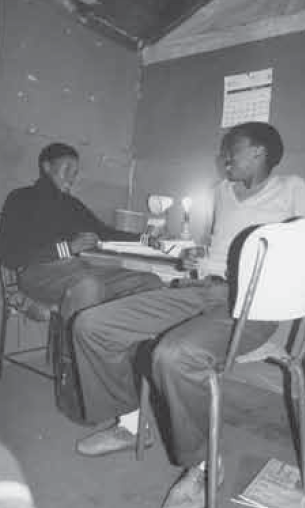
Ighsaan Schroeder looks at study groups, why they are important in the present period, how to set them up and how they should function
STUDY GROUP PILOTS ESTABLISHED
The editorial collective of the Khanya journal has initiated the setting up of four journal study groups with various organizations.
One study group has been established with the Bophelong Community Social Forum (BOCOSFO) youth, one with the Orange Farm Water Crisis Committee, another with the education sub- committee of the General Industrial Workers Union of South Africa (GIWUSA) and the fourth with activists of the Bathlabine Rural Development Trust (BRDT) in Limpopo province. A possible fifth study group is still being discussed with members of the East Rand Women’s Forum. The intention is to work with these groups as a pilot project for 2005. Experience gained from the pilot will then be used to establish more study groups as of 2006.
WHAT IS A STUDY GROUP?
A study group brings together individuals for an exchange of views and opinions on issues of concern to them. Through such exchanges study group members extend their knowledge and deepen their understanding of the issues facing them. This in turn enables them to act in a more informed way in defense of their needs and demands. The purpose of a study group therefore is not the pursuit of knowledge for its own sake. The ultimate purpose is social action, action that will advance the interests and demands of the working class. Later in this article we will spend more time on how to set up study groups and how they function.
WHY SET UP STUDY GROUPS?
The working class in South Africa faces many major problems. It is faced with an ANC government that has ruthlessly implemented neo-liberal policies on behalf of the big, apartheid-era capitalist corporations and the small number of black capitalists dependent on these corporations. The ANC’s neo-liberalism has resulted in a severe worsening of every aspect of working class life, from joblessness to poverty to growing incidence of disease and destitution.
What makes the government’s offensive against the working class possible and in turn strengthens that offensive is the decline in mass action that marked working class struggles of the 1980s and early 1990s. The South African working class is in retreat, unable to adequately defend itself. This situation is made worse by the fact that the organizations whose banner it has traditionally struggled under, such as COSATU, SANCO, the SACP and indeed the ANC itself, now constitute the ruling bloc leading the offensive against it.
Some of these developments in South Africa coincide with and others reflect a period in which imperialism has entered a new phase. Internationally, this has meant a fundamental reorganization of how the capitalist class relates to all other dominated classes, principally the working class. It has also meant a changed role for the state, the pre-eminent tool of capitalist class domination. The changes wrought have been quite fundamental, and internationally the traditional working class organizations have been unable to respond to the changed conditions in the class struggle.
The new phase of world imperialism signals a whole new cycle of struggle. This means that working class forms of organization, methods of struggle, demands, strategies and tactics cannot be a mere repeat of those of the previous period.
These will have to be discovered afresh in struggle, in the South African case with the added difference of politics now being conducted on the terrain of parliamentary democracy, instead of apartheid repression. Most important, it may be that different sections of the working class are leading struggles in this new period. Whereas organized workers and students led the anti-apartheid struggle today it is the unemployed youth and the elderly who are leading the struggles against evictions, water and electricity cut-offs and land reform. All of this can be seen in the new organizations such as the APF
(Anti Privatisation Forum), LPM (Landless People’s Movement) and the AEC (Anti Eviction Campaign).
The new, politically inexperienced activists leading these organizations are faced with having to make sense of a complex new phase in capitalism’s history, with defining what the political tasks are facing the working class in this period, and finding ways of systematically implementing these tasks in their day-to-day work. All in a context where the mass struggles of the previous period have ceased, the emerging organizations are generally weak and activists have access to very few resources. These activists need the time and the space to study the history of working class struggle, both locally and internationally. It from such a study of history that important lessons can be learnt when confronting the new challenges. Study groups are one way in which this can be done. Equally important, study groups provide activists the opportunity to study theory, to develop the conceptual tools needed to understand the laws by which society works. Study groups allow activists a space where they can consciously and collectively develop their understanding of the issues confronting the working class. By taking these issues into the mass organizations for further debate and discussion members of study groups can contribute significantly towards defining a new politics.
HOW TO SET UP STUDY GROUPS
Study groups can be set up by those interested in sharpening their understanding of present society. Students from the same school or community can do so, activists in the same organization can do so, as can workers and shop stewards, either from the same factory, union or residential area. The common factor must be a commitment to develop a critical understanding of the issues facing the working class today. The members of the group must also be committed to democratic and participatory learning, where everyone’s opinion is allowed to be heard and respected, and where no one feels they must give ‘the line’. Special consideration should also be given to the question of gender, not only in the composition of the study group but also in its functioning, with women members being encouraged to participate fully in the life of the group.
HOW STUDY GROUPS FUNCTION
An ideal sized study group consists of between three and six members. Beyond this number the group can struggle to function effectively. Bigger groups sometimes suffer from erratic attendance. Group members in too big a group also often don’t get sufficient opportunities to voice and test out their opinions.
The group decides on the regularity of its meetings and a meeting venue. The group also elects a chairperson and/or a convenor. The position of chairperson or convenor can rotate within the group, on a three-monthly basis, for example. The role of the study group convenor is to ensure regular meetings of the group, distribution of study material, to inform members of changes to meeting dates or venues and to generally ensure members participate fully in the life of the group. The convenor should also keep a register of attendance. This will allow the group to assess attendance and to address inconsistent attendance should it arise. Erratic attendance has a disruptive effect on the continuity of discussion in study groups.
The role of the study group chairperson is to guide the discussions of the group. This includes ensuring the group keeps to the topic for a particular discussion, to summarise the discussion from time to time, to highlight points of agreement and difference, to ensure that no one group member dominates the discussion and that shy members are encouraged to speak, especially women members of the group. This encouraging of maximum participation should be done in a comradely manner, without putting the group member on the spot. Group members bring different strengths and weaknesses to the group. Some members will talk more than others. Some members may not talk as much but they follow the discussion completely, and do not feel the need always to express an opinion they share with those already stated. The chairperson needs to be aware of this and not assume that those who are quiet are not following the discussion.
The group should also have scribes who record its discussions. This will act as a record and will allow the group to revisit previous discussions when topics need revisiting. Group members can also see how their perspectives and that of the group have developed over time. More importantly, study groups will be able to share their perspectives with other activists, in other study groups but also in organizations generally, through the writing of articles, for example.
There is however no one formula for how grups should function. For example, a group may decide that its members should read separately and then come together only for the purpose of discussion. Another group’s members may decide to do their reading collectively because members can immediately check with each other words or ideas they do not understand, instead of waiting until the group meets for the discussion, as is the case when they read separately. Groups have to find their own best way of functioning.
A word of caution about the limitations of study groups. Sometimes the group might discuss an issue for which there is no ready answer. For example, the group may discuss how best to bring organized workers into the social movements. There may be no clear answer to this question because the movements have not had sufficient experience from which such a discussion can draw. In this case it might well be that the answer will only be provided by future practice. It is important for the group to be aware of such instances. This will avoid endless or acrimonious debate in the group. The group itself best determines the issue the group chooses to meet around and discuss.
HOW THE KHANYA PILOTS WILL WORK
Although the Khanya journal study groups are being set up under the auspices of the journal, the groups themselves will determine the issues they choose to debate and discuss. In other words, they will not be tied to the various editions of the journal or the articles within them. For example, the Giwusa study group has started with a discussion on the role of trade unions under capitalism, an issue which has not been covered in any of the journal’s editions. The editorial collective will support the groups by suggesting readings for the topics chosen by the groups, preparing study group packs and attending group discussions when invited to do so.
The editorial collective will also initiate other activities aimed specifically at these pilot study groups. One such activity will bring the different study groups together, initially in writing skills workshops. The idea is to develop and sharpen the writing ability of the study group members. This should increase their effectiveness within their organizations but will hopefully also contribute towards their development as a pool of writers for the journal. In this way they will ensure the journal becomes the voice of fighting working class communities. Other activities will include seminars on specific topics that may emerge as a common area of concern to the different study groups and of putting them in contact with studies groups internationally.
Ighsaan Schroeder works at Khanya College. He is a member of the Khanya Journal editorial collective.
Leave a Reply
You must be logged in to post a comment.