
Nomzamo Mati looks at developments at tertiary institutions and their impact on black working class students. She also looks at the role played by Sasco.
CUTS IN STUDENT FINANCIAL AID MERGERS ROOTED IN GOVERNMENT’S CAPITALIST POLICIES
As a result of the government’s so-called transformation programme the majority of tertiary education institutions are now managed by black vice-chancellors and principals who pay themselves exorbitant salaries, in some instances higher than the president of the country itself, while implementing cuts that result in the exclusion of working class, mainly black students. The neo-liberal policies that result in cuts in financial aid and the very same government SASCO wants to shield developed unaffordable tuition fees.
The government’s neo-liberal macro- economic strategy, Gear (Growth Employment and Redistribution) requires limits on social spending to be achieved by cuts in social spending. The unwillingness of the ANC government to fund education has been revealed through the institutional audits introduced by the Department of Education. In line with instructions to cut back on student enrollments, the UKZN was required to cut student numbers by 6000 from 43 000 to 37 000.
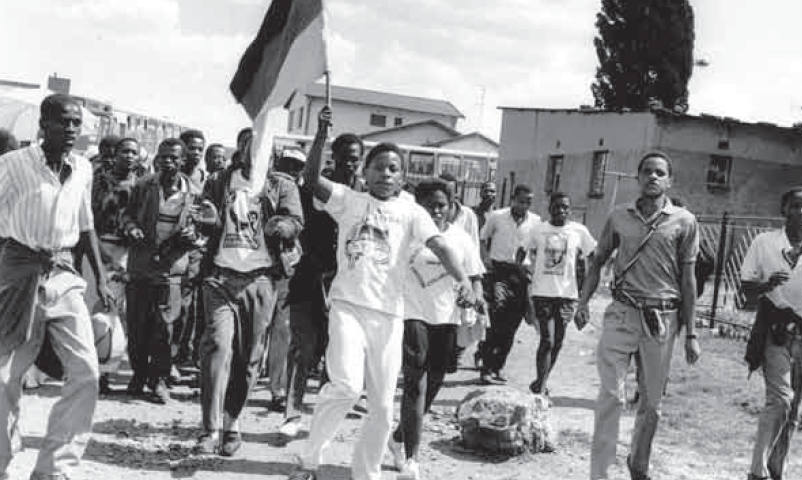
In 2005 students throughout the country reacted to this policy with the biggest wave of protests since the ANC government came to power. Protests have occurred at UKZN, the Durban and Tshwane Institutes of Technology, the Universities of Limpopo and Transkei the University and Technicon of Port Elizabeth, as well as the Universities of Johannesburg, Witwatersrand and North West. The common theme has been cutbacks in financial aid, and the discriminatory effects of the merger of tertiary institutions. The mergers have led to massive hikes in tuition fees, the unequal distribution of resources, and discriminatory language policies resulting from the swallowing up of former black universities by the former white institutions presented as mergers.
FROM RACIAL APARTHEID TO CLASS APARTHEID
The reduction in financial aid has changed the racial composition of these institutions in a manner that contradicts the stated aim of “transformation”. Whilst they have become black at the top, the initial increase in black student enrolment has begun to reverse at a number of institutions. This is the result of the fact, after ten years of capitalist democracy; the links between race and class in South Africa remain as strong as they were under Apartheid.
MERGERS KEEP OUT BLACK WORKING CLASS STUDENTS
The government claimed that the mergers were necessary to ensure greater equity of resources, students and staff. However, the mergers have had the opposite effect. Mergers have opened the door to mass retrenchment of non-academic staff through outsourcing and privatisation of eg cleaning, maintenance and catering services. It has also resulted in the further exclusion of black students in particular. The irrational, unplanned manner in which the government has reacted to the education crisis is the result of an attempt to give the impression that “transformation” is succeeding. On the one hand it has lowered the standards for passing matric and obtaining an exemption for admission to university. At the same time it has cut the student financial aid budget, increased tuition fees and tightened academic admission criteria! The result is that thousands of students who had believed that their path to university has now been eased, find themselves excluded. This is the reason for the burning anger and the escalating protests.
MERGERS INSTITUTIONALISE DISCRIMINATION AGAINST BLACK WORKING CLASS STUDENTS
The takeovers disguised as mergers have meant that there have not been any material change at the institutions themselves. During a merger fees are normally set at the level of the former white institution. The curriculum and the academic culture are based on the former white institutions.
At the newly created University of Johannesburg black students from the former Vista University and Wits Technicon suddenly found that they had to receive lectures in Afrikaans a language they had taken as a second language subject at best! The former Visa campuses are geographically located in the black townships. Yet no provision was made for subsidised transport to take them to lectures not available at their former institutions. To add insult to injury, security equipment at the former white institutions did not “recognise” black students’ cards barring them from admission.
Students at the former white institutions still have better access to resources than their colleagues in the former black institutions. Students at the former University of Fort Hare still do not have access to computers with 7 000 students having to share a photocopier while at the former Rhodes University campus these are taken for granted.
FURTHER EDUCATION AND TRAINING – A BARRIER TO UNIVERSITY FOR WORKING CLASS STUDENTS
The government’s answer to the contradiction between lower matric standards and tighter financial and academic criteria for tertiary institutions, has been to discourage students from seeking admission to university. They should look elsewhere, at Further Education and Training Colleges, the minister advises. Universities are for the privileged elite not for working class dunderheads. To facilitate this, the government has carried out institutional enrollment audits. This policy provides for mass reduction of students in tertiary institutions with Wits being ordered to roll back enrolment to 1996 levels. The government is also reintroducing what amounts to the discredited Junior Certificate to encourage students to exit the system early and not waste their time going to matric.
The DoE’s explanation for this attack on black working class students is that students are not looking at all their choices. In other words, black working class students should not try to reach for the stars. University education is apparently beyond their intellectual abilities. The government has instead marketed the Further Education and Training Colleges as the solution.
The government has defended itself by claiming that what they are contributing is the same as what other countries in the same economic status contribute to education. However, a study prepared by the United Nations Educational Scientific and Cultural Organization on public higher education funding, found that the 0.75% of SA’ s GDP spent on funding public education was lower than the global average of 0.81%. The other fifteen African countries included in the study spent an average 0.85% of their GDP. The 2004 UN Human Development Report placed South Africa 114th in the education index.
The only viable solution is to provide free education. Government apologists will argue that this is not affordable. But about 15% of our GDP is spent on repaying the interest on the apartheid debt; billions are being spent on the arms deal; the government has once again reduced company tax in the latest budget bringing the total given to big business to more than R74billion over the past ten years. The rich should be taxed to finance free education.
SASCO WITS BETRAY BLACK WORKING CLASS STUDENTS
Students have tried to fight the injustices but Sasco and the ANC Youth League have diverted their anger. At Wits University a Sasco-led SRC, in a desperate attempt to divert attention from the government, offered to use SRC funds and to fundraise after massive student protests against management’s decision to cut their financial aid by half. As the Socialist Student Movement predicted, they failed to raise the money. The result is the concessions made in that protest have enabled management to reduce students eligible for financial aid from the 3 400 who received it last year, to 2 400 this year including 200 first years.
This year the SRC took money from its budget to register the students who did not get funding. This initiative has led to the SRC being run like a company. This is simply a tactic to defuse student anger and shield the government from their wrath. The ANCYL has accused the National Student Financial Aid System of mismanaging the allocated funds. What they are really trying to say is that what government gives is adequate. These attempts to postpone the inevitable clash between the ANC- led government and students over the under- resourcing of education, was bound to fail as the student protests have shown.
The SSM, whilst fighting for free education under capitalism recognises that whatever concessions we may win, there will always be renewed attempts to reverse any gains we have won. This why we link our struggle for reforms under apitalism with the struggle to overthrow capitalism itself. The only lasting solution is the socialist transformation of society – the creation of a society where we will not produce for private profit but to fulfill the needs of society.
Nomzamo Mati is a based at the University of the Witwatersrand where she is a member of the Socialist Student Movement (SSM). This is an edited version of two articles that appeared in the May/June 2005 edition of “Izwi Labasebenzi- Socialist voice of workers and youth” published by the Democratic Socialist Movement. The SSM can be contacted at socialiststudent@webmail.co.za
Leave a Reply
You must be logged in to post a comment.