
lumko Radebe argues that formal education is used to support and sustain capitalist institutions and thus the need for social movements to come up with a rival ideology which promotes revolution and attacks entrenched capitalist institutions.
HOW EDUCATION IS PERCEIVED IN OUR SOCIETY
Education is an important tool in our society. It has a huge influence on the rest of society, which is why businessmen, educators, clergymen and government attempt to capture it by controlling schools. But knowledge can be accumulated from various institutions in our complex society, for example church, family, economic, scientific and educational institutions, and even on the street. The street includes all the practical influences of the other institutions. Institutions are the organised systems in society that influence behaviour through which norms are practiced.
Schools may offer a standard curriculum to all children but the reaction of students depends on many factors outside the control of the educational institutions. Business and labour associations attempt to influence the schools by propaganda in the guise of free “educational” materials. Politicians investigate these materials to ensure that they conform to the current standards of nationalism. Some churches operate schools of their own in an effort to guarantee that education will support religious indoctrination. But education can create attitudes which influence the acceptance or rejection of religious dogma.
EDUCATION AND IDEOLOGY
The main purpose of the dominant ideology in our society is to sustain loyalty to capitalist institutional norms. Intellectuals are those who devote themselves to analysing and explaining social developments in terms that are harmonious with institutional norms that reflect the interests of the capitalist class. Today, that means manipulating ideas to force or influence society to be submissive to neo-liberal policies. Therefore most intellectuals cannot be fully trusted because their training equips them to defend the ideology they represent.
President Thabo Mbeki has jumped onto the bandwagon of labelling social movements ultra- lefts or counter revolutionaries. According to this view of the social movements, these organisations lack revolutionary theory, tactics, strategies and do not want to engage in the democratic spheres or channels. But the main question is: what informs the ideology of these movements in their struggle?
STREET EDUCATION
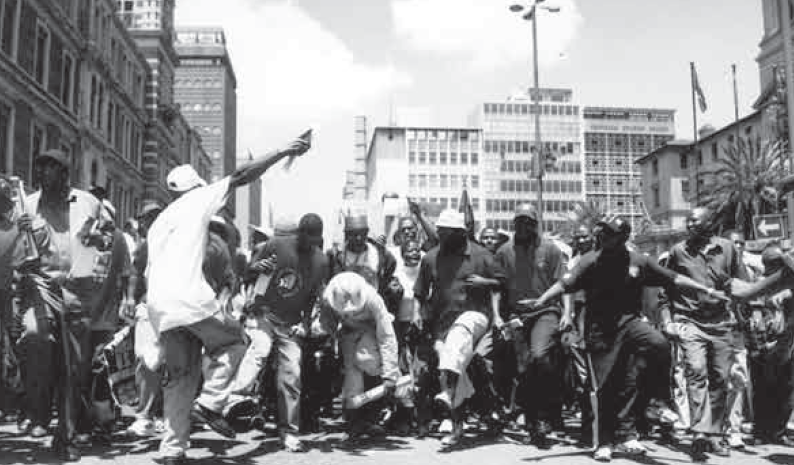
The working class faces unfavourable balance of forces and the social movements either resist or promote change. There are migratory, expressive, utopian, reform, revolutionary and resistance movements. Social movements do not just happen as they arise wherever social conditions are favourable and these conditions produce many people who are ready and willing to promote them. In the course of struggle, intellectuals from the working class may develop a rival ideology, which promotes revolutions and attacks entrenched capitalist institutions.
To build such a group of intellectuals, the Anti Privatisation Forum/Soweto Electricity Crisis Committee is running study groups. The groups have sessions every Tuesday and Thursday at the Carrer Center in Diepkloof, Soweto. The interesting aspect of the study groups is the composition of the comrades who attend and the discussions taking place. It is mainly the unemployed comrades and comrades with no formal education engaging in an activity associated with formal institutions. Therefore, is it a case of the blind leading the blind or is it a case of organic intellectuals versus institutional intellectuals?
Leave a Reply
You must be logged in to post a comment.