
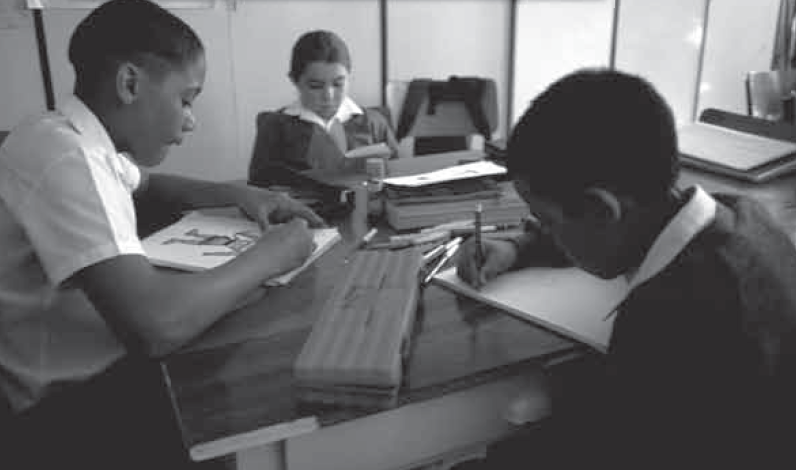
Silumko Radebe argues it is the government’s GEAR policy which is responsible for the continued crisis in working class education.
In the past three years more than 12 schools have been the subject of mergers and some schools that are well run or top achieving are being overcrowded. Mr. Kekana has appealed to Soweto-based schools to raise the standard and quality of learning as well as the standards of teaching to lure the children back to the famous township instead of letting them go to Lenasia, Eldorado Park, Newclare, Ennerdale, Mondoer and the southern suburbs. But Mr. Kekana is missing an important point that Naledi Pandor, the minister of education, has acknowledged but failed to implement in the schooling system.
GOVERNMENT IS DOING ITS BEST BUT PARENTS ARE FAILING!
“These children are being robbed, raped and others involved in accidents on their way to and from these schools outside Soweto,” says Mr. Kekana. He also adds that parents are facing the burden of transport costs to take their children to these schools. For the next seven months until the end of 2005, all schools under the control of the Department of Education are due to be subjected to a full audit. The school register of needs (SRN) audit will provide an accurate record of the improvements since 1996 and the extent of the backlogs in school infrastructure. Besides the audit, the department is also collaborating with the Public Works department and parastatals including Telkom to remove bureaucratic obstacles to ensure that no time is wasted in the construction of schools and bringing water and electricity to these institutions.
A group of 39 high school teachers from South Africa are currently attending a ten-week education training programme at the Prince George Community college in Maryland near Washington DC in the United States. The course will improve the teachers’ mathematics, physical science and technology skills. It is funded by the United States Agency for International Development (USAid) at about R10, 2 million. This course will train about 134 teachers by the end of 2005, proving that government is committed to improving the standard of education in our country by following the US model.
BANKRUPT EDUCATION SYSTEM (APARTHEID SYSTEM & BANTU EDUCATION)
All the efforts made by our government are necessary for its own benefit but this does not mean that education will be free and compulsory for all South African citizens at all levels. Our education system is from a bankrupt past and our government needs huge resources to overcome this backlog. But the same old story has been recited that “we do not have funds or resources” to be able to offer free quality public education for all. The ANC government has made commitments to the United Nation’s Millennium Developmental Goals but it lacks the political will to eradicate poverty & illiteracy by providing free public education at all levels. All the African countries’ national budgets tell a different story to their commitment to the Millennium Developmental Goals as the purchase of ammunition absorbs a huge chunk of their budgets.
“As long as our fellow parents and members in Soweto continue to enroll their children at schools situated outside Soweto, we will be left without schools, but buildings used for other community development use,” said Mahlomola Kekana, the regional secretary of the National Association of Schools Governing Bodies (NASGB) in May 2005.
1976 June 16 struggle,
WHY WE DO NOT HAVE FREE EDUCATION
The reason why parents are taking their children to private or former Model C schools is because of apartheid’s bankrupt education system, which has not been improved or is being ignored by the current government in terms of poor infrastructure. The SRN has failed to note that there has been no improvement in the past 11 years at black schools due to the government policy of not improving these facilities. The market driven orientation of the state is worsening the current situation.
THE ROAD TO RECOVERY
Our government has to scrap its macro-economic policy, the Growth, Employment & Redistribution (GEAR), and increase its public spending on education to eradicate poverty. The mergering of schools will not solve the problem and outsourcing of transport to private companies has added salt to the problem, with more than three bus strikes in Gauteng within a year which left learners stranded on the roads on their way to school. If this is the way the government is looking at addressing the problem of quality education then we are going to notice more schools being closed down in Soweto.
Sending a few teachers for overseas training is not going to address the problem of unemployment, let alone retrenchments. The government’s policy allows conditions of inequality, which cause further racial segregation. Those who can afford education take their children to schools with better resources regardless of the cost or distance. Therefore, it is a class question and not a matter of choice. The exemption policy has further caused a strain on the parents and black schools. The government is not supplementing the deficit to the school budget in working class areas.
The laws regulating schools need to be reviewed because they make school fees compulsory thereby contradicting the freedom charter, the the struggle against colonialism, the struggle against apartheid, and the struggle against class supremacy. Social movements have correctly stated “it will be a great day when our schools have all the resources and the army can have cake sales to fundraise for their ammunition”. Soweto residents must have a campaign against the merger of schools, which can become a national campaign, supported by the majority.
ALUTA CONTINUA.
REMEMBER THOSE WHO DIED IN 1976.
Silumko Radebe is active in the Soweto Electricity Crisis Committee and is a member of the AFP media sub-committee.
Leave a Reply
You must be logged in to post a comment.