
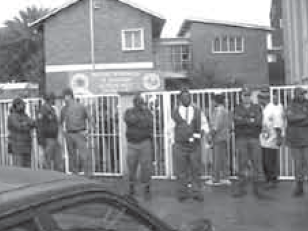
Johanne Themba Sompane argues that the promise of free and equal education for all after 1994 was utopia because of the capitalist neo-liberal policies adopted by the new government which disadvantage the poor and the academically challenged.
History has shown us that “free, equal education” in South Africa will not be easily achievable today. Judging from the direction current education thinking is inclined, the future looks even less promising, unless something concrete is done to address the issue properly. In the past Bantu education was used to limit the minds of us blacks. The apartheid regime threw black people’s ability to become technicians, engineers, pilots and so on into the dungeons. An outlet was available only to a small minority who slipped into exile and the thin layer of “privileged” urban black elite. Through the use of tools such as corporal punishment and the Afrikaans language policy, educational institutions ensured the oppression of black minds.
The South African Unemployed Youth Forum (SAUYF) was formed in response to current problems facing the unemployed, out of school youths in our region, Sedibeng, in particular and in largely black poor townships across the country. The Forum was formed in January 2004 and has seen tremendous growth since its formation. Part of the reasons provoking its formation was the collective realisation that promises made by our municipal mayor and his gang of councilors have been nothing but hot air, intended to keep young peoples’ fighting spirits at bay.
Very little has been said about the impact and causes of unemployment, least of all in the commercial media. What direction is “transformation” taking and have poor people benefited? The official position states that globalisation requires the South African economy to be integrated into the global economy, and in this process it needs to “adjust” itself to operating on a global scale. This means that individual nation states need to withdraw from involvement in the economic functions and limit themselves to regulating and overseeing market forces. The one way to do this is by cutting down on government spending through measures such as privatisation of state utilities concerned with provision of social services such as water, electricity, health and education. This, the logic continues, will encourage private competitiveness and improve the quality of services.
In our experiences and those of poor people all over the world these policies have resulted in massive job losses, while whole sections of the population have been shunted to the periphery and excluded from the “formal” economy. Contrary to assertions made by state technocrats and priests of the Growth, Employment and Redistribution (GEAR), this has not only led to “jobless growth” but to “Job Loss Growth”.
It is our contention that the demand for free, equals education will remain nothing but a distant dream given the capitalist, neo-liberal policies adopted by the State. The State promotes policies that encourage an individualistic, competitive spirit where the survival of the fittest is the principle for achieving a good quality life. If you are not wealthy enough or “clever” enough then your life is characterised by disease and hunger.
Those that rule over us know that education is a weapon with which the marginalised can strike blows at the legitimacy of those in power. How can they then give these weapons freely? Rather, they make profits out of the ignorance and gullibility of a population that is poor and illiterate.
Since ‘Uhuru’ we have seen massive cuts in social spending by the neo-liberal South African state, including spending on education. At tertiary institutions we have seen systematic cuts in subsidies, forcing institutions across the country to annually raise tuition fees and the cost of registering. The bursaries available to poor students have been dwindling while student aid schemes such as TEFSA and NAFSAS are prioritising high academic achievers for loans that are repayable upon the students’ graduation.
At secondary level, poor communities are still pushed to pay learner admission fees and annual school fees, with very little information given to parents of the exemption policy. Also, we see rising intolerance for learner formations that “bring community politics into the classroom”. The South African Schools Act explicitly states that no other learner representative structure is officially recognised apart from the legislated Learner Representative Council, effectively shutting down all legal means by which alternative learner voices and representation can exist within the school yard.
At primary level, learners are plagued by insecurity and alienation, their poverty or that of their families being seen as a reflection of their own failures. Gates continue to be locked at lunch time regardless of the fact that school based nutrition programmes are generally non-functional, if they exist at all. We see children going to school in tatters because their parents cannot afford to buy school uniforms. The children face constant humiliation from peers and some teachers, which affects their dignity and self-esteem.
The experience of education transformation has been consistent with the imperatives of capitalist goals of profit and wealth generation. It has had nothing to do with the responsibility of the State to redress inequalities in the lives of the majority of poor people.
Our teachers have also been affected. Most are qualified yet do not have the security of permanent placements, which has often resulted in low motivation to teach as well as lack of confidence
in teaching. Most teachers are from a militant generation that spear- headed the struggle for an education that is free, but casual conversations with our teachers reveals that they have lost hope in the struggle for free quality education. We urge our teachers to take the struggle approach to teaching.
The Freedom Charter demands that the doors of learning and culture shall be open, that the government shall discover and develop national talent for the enhancement of our cultural life, for the free exchange of ideas and that education shall be free, compulsory, equal and universal for all. What happened to these demands?
Our votes were a mistake. We were misled by utopian manifestos and festive election rallies. They have been wolves in sheep skins, promising us an egalitarian society yet all along they were not necessarily opposed to capitalist exploitation, the driving engine for the construction of apartheid oppression.
AZANIA SHALL BE FREE! –
Johanne Themba Sompane is a member of the South African Unemployed Youth Forum.
Leave a Reply
You must be logged in to post a comment.