
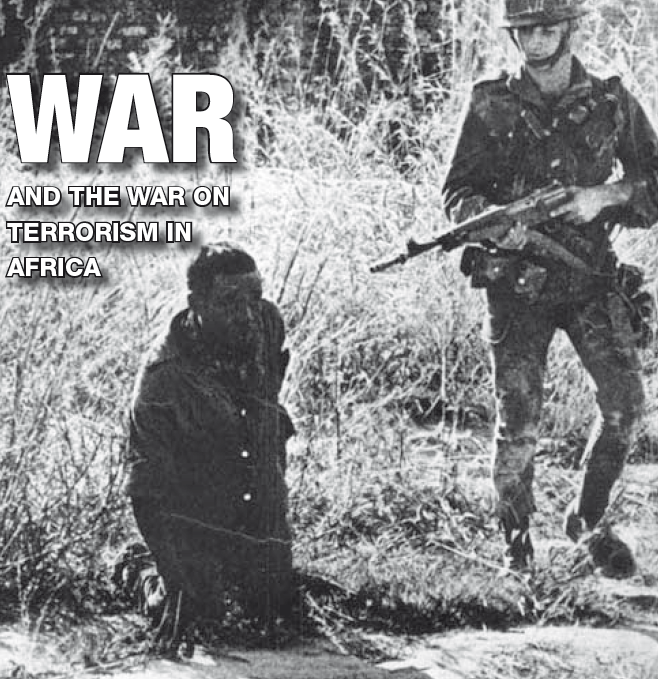
Theaters Of War
The African continent is in bad shape and has been so for much of the 20th century right into the 21st century. Devastating civil wars and political conflicts has touched most parts of the continent.
For example, Angola is in its second year of peace after a brutal 25-year civil war that pitted Western backed rebel forces the National Union for the Total Independence of Angola (UNITA) against the Marxist government of the Movement for the Total Liberation of Angola (MPLA). During the civil war, hundreds of thousands of civilians were killed while millions of people were displaced internally and others forced to flee into exile in neighbouring countries and abroad. Mozambique’s own civil war, which lasted for 30 years, ended ten years ago, while South Africa celebrated its first decade of democracy in 2004 after the demise of the repressive apartheid system. While conflicts have been simmering down in the Southern part of the continent, the new theatre of war appears to have re-located to Central Africa (the Great Lakes Region), West Africa and parts of the Horn region (Somalia and Sudan). Since the early 1990s, Rwanda and Burundi have experienced an on-going full-scale civil war, which in 1994, led to one of the worst genocides in modern history. The majority Hutu killed almost a million people, members of the minority Tutsi group in Rwanda.
The Democratic Republic of Congo (DRC), former Zaire, has been at war for almost a decade now and at one time had armies from five African countries plying their support for either the government troops or the opposing rebel forces. Uganda and Sudan too, are waging war against rebel groups, while Ethiopia and its former satellite state Eritrea regularly engage in skirmishes on the question of their common international border. Somalia is a failed state.
In West Africa, Liberia, Sierra Leone and Cote- d’Ivoire have been characterised by violent strife or outright civil war. The conflict in Liberia took a break in mid 2003 when the then President Charles Taylor reluctantly agreed to step down from power and move into exile in Nigeria. Sierra Leone’s conflict, which came to an end in 1998, saw the international community pool together its collective resolve and establish a special international tribunal to try and punish many former rebels for committing crimes against humanity. Cote- d’Ivoire, a country that for many years was hailed as a bastion of peace and prosperity in the region, has since descended into bloodshed and chaos.
Its government led by President Laurent Gbagbo is currently propped up by troops sent by the country’s former colonial master, France.
Post independence and the state of the African continent
Africa owes its problems not just to its contemporary history but also to the notorious slave trade and to colonialism which mostly took place in the 19th century. Over a thousand years, approximately 50 million Africans were sold into slavery through the Indian Ocean, the Atlantic Ocean, the Red Sea and the Trans-Saharan caravan routes. Slavery did not only deprive the continent of its most able-bodied men and women, it also destroyed Africa’s political, economic and social institutions and laid a fertile ground for its later conquest by Europe.
Given this background, it is almost impossible for African countries to recover sufficiently enough to reconstruct their societies. Furthermore, Africa’s decolonisation coincided with the onset of neo- imperialism, the cold war and globalisation.
Because the continent was subdivided randomly without any regard for the various nations and their own forms of government, common ethnic groups found themselves ruled by different European powers and after independence, these people were scattered across boundaries. This social and political disenfranchisement is evident throughout the continent, including Southern Africa, and one finds that the peoples of the region typically relate to one another but are within different international borders.
Even with formal political independence, there was no genuine desire by the colonial forces to retreat from the continent. With the onset of the cold war, the two super-powers, America and the Soviet Union, rushed to create their own spheres of influence. In the last 40 years there have been dozens of coup d’etats, attempted coups (Equatorial Guinea being the most recent example), dictatorships, unprecedented poverty and now the HIV/AIDS pandemic.
Developed countries, through the international financial institutions (the International Monetary Fund and the World Bank), multi-national corporations (BP, Shell, Microsoft, Coca Cola, McDonalds, Barclays Bank etc), multi-lateral organisations (the United Nations, the World Trade Organisation) and funding agencies (Ford Foundation, USAID) dictate the pace and progress of development for African countries.
Structural adjustment programmes (SAPs) have been imposed on oftentimes unwilling or misinformed governments. Writing in 1995, two political economists Kidane Mengisteab and Ikubolajeh Logan summarised the failures of SAPs on the continent in the following terms:
- They do not appreciate the different economic regimes and recommend the same prescriptions across the board, e.g. they prescribed the same solutions to Mobutu’s then self-serving regime in Zaire (now the DRC) as they did to the then reform-oriented government of Mugabe in Zimbabwe.
- They fail to address sub-Saharan Africa’s position and role in the international economic system and cannot address issues of international trade.
- While claiming to address structural reform in the domestic economy, SAPs fail to accommodate the dynamics of the peasant/ agrarian sector.
Africa and the ‘war on terror’
Since the terrorist attacks against America on September 11 2001, the world has, as described by many people during the illegal United States led war against Iraq in 2003, become an even more dangerous place to live in. Africa too has been ensnared into this vortex of chaos, which
US President George Bush disingeniously defines as “the struggle of the civilised world against the forces of evil”.
While embers smoldered from the ruins of the previously imposing World Trade Centre twin towers in downtown Manhattan, Bush made his now famous remarks: “Either you are with us, or against us,” which in effect meant in league with the ‘terrorists’.
Bush’s virtual declaration of war against the world quickly found support in the West and a few weeks after the September 11th attacks, America invaded Afghanistan with a sympathetic world tacitly supporting the drive against the Al Qaeda network and its guardian protector, the Taliban regime.
What has continued to raise the anger of many people, however, is the manner in which the US has continued to treat those captured in active combat in Afghanistan and subsequently detained at the American military base of Guantanamo
Bay in Cuba. Whereas international law decrees that all persons captured while engaged in active military combat during armed conflict are to be treated as prisoners of war, the Bush administration proclaimed that the conventional soldiers in Afghanistan were terrorists and would be treated as such. Bush’s unique interpretation of the humanitarian laws of warfare have led him to conclude and declare that the prisoners in Guantanamo Bay are not subject to the protection of the Geneva Conventions.
Last year, Bush led a seemingly gullible American public into war on Iraq on the dubious claims that Saddam Hussein possessed weapons of mass destruction, that his regime had a role in the September 11 attacks and that it also had links with Al Qaeda. Resistance to the American invaders has continued since Bush declared an end to major combat in April 2003. A few months ago, the international community was horrified when images were flashed across the globe of torture and serious mistreatment of Iraqi prisoners held at the Abu Ghraib prison in Baghdad by American soldiers. Only a handful of the foot soldiers have been court marshalled but it is not lost on the world that the tortures were no doubt sanctioned from higher up in the US military hierarchy as well as by the governing administration.
Many sympathisers of America’s tragedy during September 11 may have not foreseen that the “war on terror” would eventually result in a significant threat to international peace and security. It is a war that has quickly assumed new dimensions:
- It lacks precision, and it shows no inhibitions;
- It is an all out battle against everything and nothing;
- It is a war against the world.
To borrow from Amnesty International’s Secretary General Irene Khan’s comments in their 2003 annual report, the war on terror is a self-deluding adventure that:
“Far from making the world a safer place, has made it more dangerous by curtailing human rights, undermining the rule of international law and shielding governments from scrutiny. It has deepened divisions among people of different faiths and origins, sowing the seeds for more conflict.
The overwhelming impact of all this is genuine fear among the affluent as well as the poor.”
Legislative overkill: The anti- terror laws
One of America’s prescriptions for states in the ‘war on terror ’ has been its demand that all countries must demonstrate their good faith by enacting anti- terrorism laws. As a result therefore, governments in Africa, just as in the rest of the world, have quickly seized the excuse presented by September
11 to curtail even further those individual rights and freedoms they could not manage to legally infringe before.
The argument made by these states is that there is an international consensus and commitment around the need to combat terrorism by, among other things, enacting anti-terror legislation and adopting relevant measures at both the domestic and international level. In so doing, states religiously chant the mantra of Resolution 1373 of September 28 2001, which requires them to take measures for the purpose of ensuring that:
“Terrorist acts are established as serious criminal offences in domestic laws and regulations and that the punishment duly reflects the seriousness of such terrorist acts.”
States have often made the claim that this resolution ties their hands. They argue that it requires them to enact “terror-specific laws”, irrespective of how draconian such legislation turns out to be. Some Third World countries have found themselves in the unenviable position of having to invent anti-terror laws of which they have a scant understanding and often in total disregard of the massive opposition shown by their own populations.
A major problem attending this new haste in the global war against terror is that there is no internationally accepted definition of terrorism. Different states apply different definitions and what may be considered as terrorism in one country may perhaps be viewed differently in another more liberal state. But this divergence is continuously narrowing and soon, governments of the world, led by the US and the United Kingdom, may arrive at a consensus on what they believe to be acts of terror.
Presently the South African government is struggling to find a reasonable definition of terrorist acts so that it can pass its own anti-terror law. No less than four definitions of terrorism have been offered in the various drafts of the bill placed before parliament since March 2003.
Civil society has come out in strong opposition to this law pointing out that it is draconian, ill- informed and unnecessary. An attempt by the new Kenyan government to introduce anti-terror legislation in 2003 after strong pressure from Washington was met with fierce resistance by the public, civil society organisations, opposition parties and religious institutions.
Other measures such as economic pressure have been applied to those countries that have not yet instituted anti-terrorism legislation. The number of states forced to cooperate in the surrender of people suspected of engaging in ‘terrorist activities’, largely in violation of the long established principles and rules of international extradition, has become alarming.
To cite one such example, in June 2003 on the orders of the US government, Malawi authorities arrested and illegally handed over five Muslims to the US Federal Bureau of Investigation (FBI) on claims that they were terrorists. This was despite the fact that some of them were not even Malawian citizens and the court had ordered that they should not be deported. Protest activities, which ensued in demand that the men be returned and charged domestically, were violently put down by the Malawian government of the then President Bakili Muluzi. All five men were later released.
Refugees and the ‘war on terror’: No more safe havens
Refugees are perhaps going to be some of the worst affected people by the new shift and emphasis in the world’s state of affairs. Foreign countries are eager to deny asylum to people persecuted by their own governments, especially if they can somehow allege that such people have committed ‘terrorist offences’.
In their thrust, Anti-terrorism laws largely target foreigners, immigrants and asylum seekers for detention without trial or charge. This has become the norm in what is now irreverently referred to as “fortress Europe and America”. Europe and America have virtually turned themselves into impregnable citadels and are exceedingly hostile to refugees and asylum seekers. From the early
90s, many European states began to tighten their asylum and refugee laws. This includes many liberal democracies that have been the bastion of refugee protection such as Germany, which amended its Constitution (Article 16 of the Basic Law) so that any person who passes through a third country considered to be safe will not be eligible for recognition as a refugee.
Refugees may soon find that their outspokenness and opposition to tyrannical governments in their countries of origin may be equated with terrorism and, once they move to other countries to seek refuge, they could be denied asylum. On the other hand, once refugees are granted asylum, the protecting states are likely to frown on the constant criticism of their home governments.
The war on terror is undermining international law, and more so the law of extradition. In October
1999, the South African authorities handed over Tanzanian asylum seeker Mohamed Khalfan to the American FBI. He was suspected of being a member of Al Qaeda and of being part of the group that bombed of the US embassies in Nairobi and Dar es Salaam in August 1998. After application by Khalfan’s lawyer, the South African constitutional court ruled on May 28 2001 that Mohammed’s deportation had been unlawful because the government had not “sought assurances from the US government that Khalfan would not be subjected to the death penalty.”
The court further held that the government had failed to uphold the rights enshrined in the constitution, which were applicable even for foreign nationals residing in South Africa illegally, and which the government was constitutionally bound to uphold.
Resolution 1373 cited below even gives directives for making inroads on the practice of international refugee law by requiring states to:
“Ensure that in conformity with international law…refugee status is not abused by perpetrators, organisers or facilitators of terrorist acts, and that claims of political motivation are not recognised as grounds for refusing requests for extradition of alleged terrorists.”
A very worrying and ominous situation is created by this resolution. It would have been acceptable to make such a provision if it was possible to define the offense of terrorism with sufficient clarity and if indeed there were democratic systems in the world. Unfortunately this is not the case.
By Simon Kimani Ndung’u. Simon is the head of the Anti-Censorship Programme at the Freedom of
Expression Institute in Johannesburg.
Leave a Reply
You must be logged in to post a comment.