
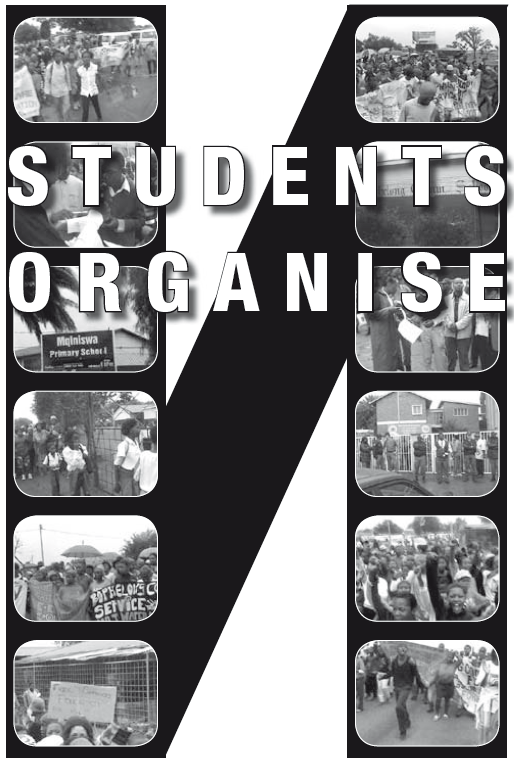
Over the past few years we have seen considerable growth in emerging social movements in terms of the number of constituent community organisations taking part in struggles, as well as the scope of issues covered. It is within this context that education has increasingly become a key demand within
South African social movements, drawing in a wide layer of young activists confronted with the brutal realities of increased impoverishment and declining prospects for a dignified life.
The campaign around education has made it possible for students to link general economic justice struggles, e.g. for decent housing, free electricity and water, to school level struggles around school fees, school governance and the inadequacy of school feeding schemes.
A critique of South African education is that whilst education policy gestures towards equality in the education system, in reality inequalities that characterised the separate development of the apartheid education system continue. In most instances the socio- economic disparities of the past are worsening. In response, this critique calls for a free, single and resourced public schooling system for all.
Political responses that have emerged from communities have ranged from campaigns based on immediate demands made to local authorities to establishing links with other communities in an effort to create a national campaign around the right to free and quality education. This is the case for instance in an informal settlement, Mandelaville, which was forcibly removed from Soweto and literally dumped in the middle of an abandoned mine dump in the disused mining area in Roodepoort-Durban Deep in the West Rand. The immediate problem of lack of any infrastructure including an absence of schools meant that learners needed to travel great distances to reach the nearest schools. The immediate political demand in this community was the provision of free school transport for all. After many struggles with the education district office, free transport is now provided.
Mandelaville is but one instance of numerous expressions of the struggle for free education. More and more, there is a growing trend towards a more generalised response to what may seem like local problems. This has taken the form of examining and exposing the contradictions of education policy and pointing out the huge gap that exists between stated policy and the lived experiences of poor communities.
There is widespread acceptance in social movements that a campaign narrowly defined by the discourse of state through statutes such as the South African Schools Act, while promising solid immediate gains, will not go far enough to addressing other areas of educational inequalities. In some communities the demands include areas of provision such as Adult Basic Education (ABET). The Education Rights Project and communities in the Vaal have begun a campaign that seeks to combine tactics such as meetings with officials, marches and participative projects so as to diversify modes of resisting.
As the national campaign on education unfolds and develops; the view that understands schooling, or education more generally, to be an integral part of the political-economy of capitalism will be strengthened. Of necessity, therefore, the function of the campaign will be to expose the role of the current education system in promoting the neo- liberal political and economic agenda of the state and to draw inspiration and lessons from the global social justice movement and in developing and struggling for alternatives – not just educational alternatives – but general alternatives to the entire system of capitalism.
The campaign is at its early stages but has seen some dramatic successes, such as having been one of the key reasons why the state reviewed parts of its policy on school fees in 2002. Clearly the campaign is a positive development, but it poses real challenges to the ways in which we organise. The layers of learners that continue to be drawn into the campaign recognise the shortfalls in their education, but many have not gone beyond the concerns of a particular experience of learning in their schoolyards. The links are apparent but by no means obvious. This will influence the manner in which we approach organising. We have to find a way of developing a thorough-going critique of schooling under capitalism as we build a campaign to challenge the hegemony of capitalist ideas in education.
The Learner Representative Forum and theCconcerned Leaners Forum (CLC), both of Lekoa / Vaal, are examples of organisations that have sprouted from within the school institution and filled the void left by current Representative Councils of Learners. They find a way of fighting and agitating for changes within school premises, yet at the same time participating in political spaces outside of the narrow confines of the school fence.
Three questions must be thought about as we build the campaign. How do we on the one hand, base our programmes on the concrete experiences of learners; and yet on the other hand make the campaign speak to the national and global forces that shape the day-to-day experiences of learners? How do we ensure real political control of the campaign by the participants in the context of resources being controlled by resource organisations? The assumption made in this article has been to view the education struggle in terms of a campaign. This is quite intentional, but by no means uncontested. There are some who would like to see it as an organisational form.
This is the third question that we need to think about: whether it is possible to build our struggles on the ground without generating a plethora of skeleton organisations with very little connection to solidarity at the site of struggle?
Finally; we all have the revolutionary conviction that this is potentially the birth of a powerful surge, an opportunity to use all our creative energies and minds in creating new ways of imagining our collective efforts with which the hegemonic discourses of capitalism can be exploded. Spaces where all can converse and contest views without fear. Spaces without structural enclosures, which provide opportunities to grow, to learn, to laugh and fight!
*molefi ndlovu works for the Education Rights project and is a member of the Anti-Privatisation forum.
Leave a Reply
You must be logged in to post a comment.