
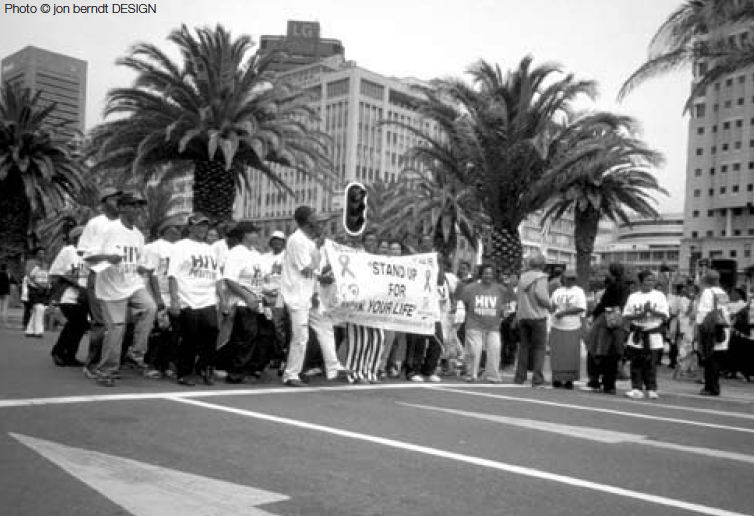
The HIV/AIDS pandemic in southern and
South Africa has resulted in widespread social problems and individual suffering. Among those living with HIV/AIDS two groups are most affected – women and youth.
In South Africa, around 5,3 million people live with HIV. According to a recent study, 10,2 per cent of all young people are infected with the virus. On the African continent, young people are the most hard-hit by HIV/AIDS. This is partly because a large proportion of Africa’s population is made up of young people. Most these young people live in deep poverty – with little or no access quality education, jobs that pay a living wage, and adequate healthcare facilities. The result of such destitution makes it very difficult to distribute information about the virus and to treat those who suffer from it.
Women of all age groups are more vulnerable to HIV/AIDS than men. 55 per cent of adults infected in sub-Saharan Africa in the year 2000 were women. Some of the reasons for this are of a biological nature. For example, that there is more virus in sperm than in the discharge of the vagina, and women are more sensitive to sexually transmitted diseases (STDs), which in turn increases the risk of contracting HIV. But it is the social circumstances in patriarchal societies – that is, societies where men have more economic, social and political power than women – that is the main force behind the higher number of infected women. In South Africa, women make up a small part of the formal workforce. In 2001-02, only 36 per cent of workers in formal employment were women. Despite the very high unemployment rate in South Africa, and despite the very low wages and insecure working conditions of many jobs, men in general have more financial stability than women as they make up the majority of formal workers. When women work, they often have the lowest paid and most insecure jobs in the labour market. This makes it difficult for women to protect themselves from sexual exploitation because of their weak economic position. So that in order keep a partner, in other words to keep a provider of resources for themselves and their children, many women find that it is difficult to ask or compel their partners to use condoms, or to demand that their partners become faithful. Women who have no source of income and turn to prostitution are even more prone to contracting the virus.
The high level of gender-based violence against women in South Africa – which includes sexual abuse, rape and domestic abuse – is another reason why more women than men acquire HIV. The fear of violence may prevent a woman from demanding the use of condoms, in case her partner would suspect her of being unfaithful. Rape is also a significant means by which the HIV virus is transmitted.
With teenage girls the picture is quite bleak. In a recent survey, quoted in THISDAY of 19 May, it was reported that of all HIV-infected young people (between 15 and 24 years), a whole 77 per cent were female! According to one of the researchers, the difference between the HIV-AIDS infection rate
of young men and young women in South Africa is the biggest ever noted any international study. While more research still needs to be done to find out why this is the case, some of the factors outlined above are thought to be the major contributors.
This shows in general that girls and women from an early stage have little or no control over their sexual lives. They have little choices about with whom they have sex, when and under what circumstances, and this is partly what makes them vulnerable to HIV infection. In this instance, financial dependency, sexism and the oppression of women is, literally, a deadly combination.
Young people, by getting involved in organisations such as the Treatment Action Campaign, Anti-Eviction Campaign, Youth For Work, or Anti-Privatisation Forum understand that the fight against HIV/AIDS is also a fight against those who keep us in poverty and forced ignorance. But the link between the struggle for social emancipation, women’s emancipation and HIV/AIDS is still not well-understood and elaborated even in the programmes of social movements. In order to stem the tidal wave of AIDS related deaths and to survive the pandemic, we must tighten the links between our struggles and the struggle against HIV/AIDS.
*Linn hjort is a member of the coordinating committee of the Workers organisation for Socialist Action.
Leave a Reply
You must be logged in to post a comment.