
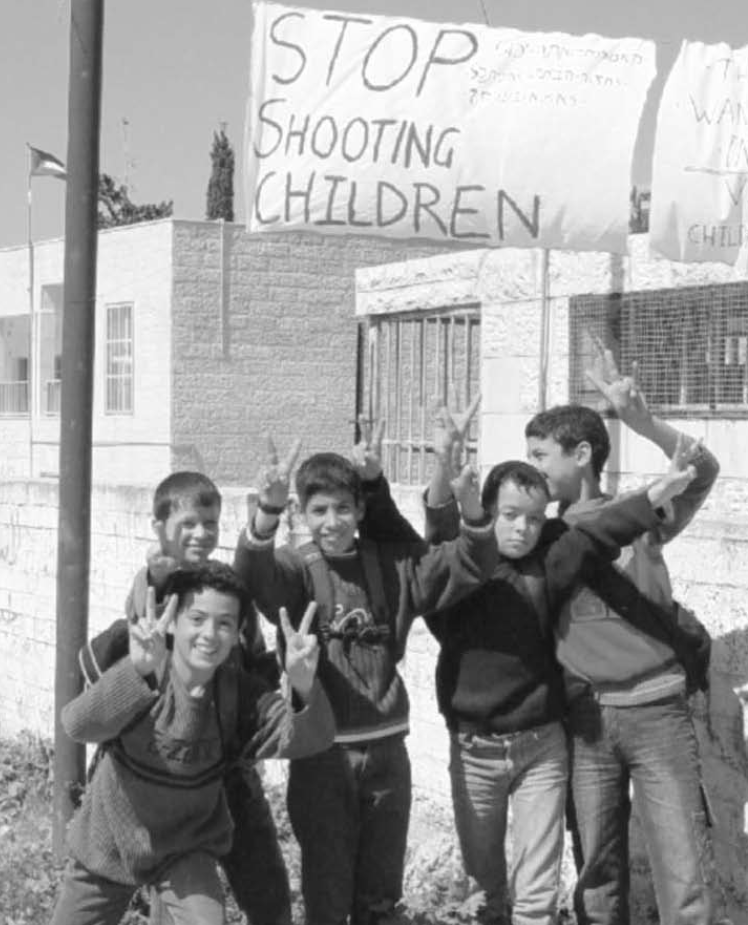
A group of students, academics and workers from the Right to Education Campaign based at Bir Zeit University, Palestine, visited South Africa in February 2004.They were hosted by the Palestine Solidarity Committee. Their aim of their visit was to understand education issues in South Africa and discuss the serious problems confronting students and staff in Palestine. The Palestinian comrades met many members of South African social movements and addressed students in schools and universities. The tour was a great success.
The right to education in Palestine is non- existent. 230 000 learners and over 9 300 educators are unable to reach their classrooms regularly. This is a direct result of the Israeli military occupation of Palestine.
Occupation of schools and curfews
About 580 Palestinian schools have been closed or occupied by the Israeli Occupation Forces (IOF) and used as military bases or turned into jails. It is virtually impossible to get permission from Israel to build new schools. When these rare new schools are built, they are easy targets for occupation. An example is the new Dar al- Kalima Model School in Bethlehem, used by 240 learners. For most of March 2004, learners could not attend school because of an on-off occupation that began when three Israeli tanks occupied the premises. After pressure by the Bishop of Bethlehem and the international community the tanks withdrew after 3 days. But then the whole area was immediately put under curfew by the Israeli army.The road to the school was also torn up by deep trenches made by IOF bulldozers. It was only possible to access the school through a much longer route on foot. Damage had been done to all the classrooms and even the childrens’ artwork. The school was occupied again a few days later and educators feared that it was going to be used as a detention camp for Palestinians that the IOF continually rounds up from the neighboring Dheisheh Refugee Camp.
Imprisonment of learners and their abuse in prisons
As at May 2004, 373 Palestinians under 18 are being held in IOF detention centers and prisons, nearly all on “charges” of stone throwing. Several are under
14 years of age. At least 300 of the prisoners were found to be subjected to physical and psychological abuse in jail, like Odeh Abu Zaanonah, 15, who was detained in the southern West Bank city of Hebron in 2003. He said he was punched, kicked, solitary confinement for the first three days. He was not allowed to call his parents or a lawyer. “One of the soldiers threw me as hard as he could against an iron door and then banged my head several times against the hard iron,” Zaanonah said in his testimony. “The other soldier … was jamming the barrel of his machine gun into my back again and again.” Zaanonah was detained for 70 days. More than 2,500 Palestinian children have been arrested and detained since the outbreak of the second Intifada. Educators face the same problem.
Killings, demolitions, sniper attacks on schools
In April 2004 alone, 22 learners were killed by the IOF. This has been a consistent figure over the years.Learners from refugee camps near cities, like Balata camp in Nablus, are specifically targeted by snipers and gunfire from tanks on their way to and from school. Disabled learners are often killed at checkpoints or in their schools. Two years ago at the El-Amal School for the Deaf in Rafah, Gaza Strip, 16-year-old Shadi Siam, was shot in the chest and died. Learners from the Gaza Strip, particularly Rafah refugee camp which borders Egypt, are often assassinated. But assassinations of learners also happen in small villages. In April and May 2003, four learners in Qarawat Bani Zeid village near Ramallah in the West Bank were executed by IOF snipers – two inside the schoolyard. In the same village in 2004, another pupil was beaten and left for dead, another had his intestines shot out, and two more were shot at close range by rubber coated steel bullets.
In May 2004 the El-Amal School for the Deaf in Rafah came under threat after 10 days of massacres by the IOF in the refugee camp community. The school is one of the remaining buildings left facing the IOF’s “shoot to kill Philadelphi strip” – a wasteland of bulldozed former homes adjoining the Egyptian border. By the time you read this article, the El Amal School may be demolished. All 131 deaf students between four and 16 years old had to write end of year exams one month early and then stay at home for their own safety to avoid being massacred. Principal Mr Abu Sharakh said, “There used to be ten houses between us and the border. Now we are the last building on the front line. They are determined to destroy all the buildings along here and we are in the way,” he said. In February
2004, the IOF seized the school and used it as a snipers’ nest for two days, shattering most of the windows on the upper floors and smashing 51 doors even though none was locked.
Gender, Violence, and Education
Apartheid Wall
In September 2003 when the new school year opened, many learners faced problems due to the Apartheid Wall. In the village of Jubara, the Wall separated learners from their school. In villages affected by the wall (the entire North West 1948 Palestinian towns that remain inside Israel face racism and discrimination. Although they are considered to be Israeli citizens, they are educated in a public school system wholly separate from the Jewish Israeli majority. Their schools are overcrowded and understaffed, poorly built, we must survIve the vIrus: sexIsm, youth and hIv-aIds
Bank) access to school depends purely on whether the soldiers will open the gate in the Apartheid Wall. In this tiny village of 500 residents, 50 primary school learners aged from five years old and another 38 learners must face the barrel of a gun every morning. Before the wall was built, learners were able to walk to school or pay 75c to take a taxi. Now there is no way for the taxi to pass through the gate. And if the gate is not opened, learners have to walk around (several kilometers) to a checkpoint and wait in a long line to pass through. After the checkpoint, they must take a taxi on the dirt road to school, which costs R8 each way. Since almost all of the families in the village are unemployed, they choose between sending their children to school or having food to eat.
The Iof and Israeli settlers unite against learners
Sawiya village lies on either side of a settler highway that was built through the village several years ago. It is isolated from the closest cities by checkpoints and settlements and faces continuous violence from the Israeli military and settlers who have been expanding on the hilltops. In 2003 the IOF declared a permanent Closed Military Zone between Sawiya and its neighbouring village, Lubban. The girls’ school of Lubban and the access road to the boys’ school fell in this zone. Learners and educators in both schools have been denied permits to access the Closed Military Zone. Over the past three years, settlers raided the school over ten times, causing major destruction. In one raid,
45 settlers set fire to classrooms, books, computers, files and furniture after entering the school through a gate less than 100m away from a Palestinian house occupied by Israeli soldiers. The village collected money to replace lost property and redecorated the school, only to find the settlers back two months later to steal the new computers and do more damage to the buildings.
In May 2004, Israeli settlers occupied rooftops in the Old City of Hebron and poured boiling water on learners who were walking to school.
Apart from the brutalities of the IOF, Palestinian learners face all the same problems as South Africa’s working class learners. All Gaza learners face problems of hunger. Schools are overcrowded and derelict.
The 1.6 million Palestinian learners living in and badly maintained. The Israeli Ministry of Education allocates less money per head for 1948 Palestinian learners than for Jewish children.
Campaigning in Palestine for the Right to Education
All the various international bodies (UNICEF, Amnesty International, Save the Children and others) are agreed that Palestinian children are being denied their right to education because of the IOF. Dozens of reports on violations of children’s and learners’ rights are churned out by these groups and other NGO’s.
But since the right to education can only be won by Palestinians through struggle on the ground against the Israeli Occupation, Bir Zeit University’s Right to Education Campaign and international solidarity groups working in Palestine have chosen to use direct action instead of diplomatic lobbying.
This includes united learner, educator, international and community actions to remove and march through checkpoints. It includes massive organised defiance of curfews. In cities like Hebron where heavily armed fundamentalist paramilitary settler groups roam the city daily in search of Palestinian targets, two international groups accompany learners to school every day. Palestinian Popular Committees have organised children’s marches against the Apartheid Wall and convened camps inside schools under threat. International activists have set up permanent presences at some schools where they aim to chase out snipers and hold spontaneous solidarity protest marches with Palestinian learners against military tanks and jeeps as they approach schoolyards. More grassroots international solidarity is needed to enforce the Palestinians’ right to education.
Anna Weekes is a member of the Palestine
Solidarity committee (South Africa)
Leave a Reply
You must be logged in to post a comment.