
In most township schools teachers are using uniforms to discriminate against those who cannot afford to pay for school uniforms. In schools around Soweto learners are constantly locked out of schools for not having a full uniform. The uniforms issue affects all school children but more so children living in informal settlements who are forced to move house every other year, which means changing schools and changing school uniforms.
I guess schools, particularly poor schools, require school uniforms for the right reasons. Learners in a school come from different socio- economic backgrounds, thus they will be many poor learners will not be able to buy a variety of civic clothing in the place of school uniforms. Poor learners will not have enough clothes to change into everyday and this might have a negative effect on their school experiences. This argument is understandable.
But the difficulty that I have is that schools are in fact making life miserable for exactly those learners, poor learners, that uniforms are supposed to protect. Teachers in schools that I was a student at in the township seem to believe that wearing a school uniform makes one a good or a bad learner. Teachers are aware that many learners are poor. The department to assess the income levels of parents issues countless forms and surveys or guardians of learners, but these studies do not seem to bring about positive changes in the school. Learners are told instead of buying or accepting Christmas presents, they should rather use this money to buy school uniforms. In other words, poor children should not have a life outside of school.
Teachers should therefore take some of the blame for driving children out schools. Ultimately the department of education must take responsibility for all these violations of the rights of learners to an education, regardless of whether or not they have a school uniform. Although school uniforms are not compulsory by law, the department of education has done very little to protect children who are refused access to education because they do not have a school uniform. It is not surprising that the department has done little about uniforms because the department does very little as can be seen with the rampant fees-based discrimination in schools.
I think that schools should have a standard uniform provided free of charge by the state. I doubt that the government will do this for it is reluctant to provide free basic services to the public. Instead the government is introducing and expanding the pre-paid programme for essential services like education, water, electricity and housing.
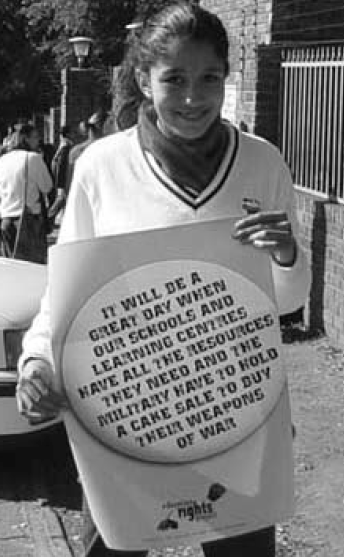
As the Education rights Project says, “It will be a great day when our schools and learning centers have all the resources they need and the military has to hold a cake sale to buy their weapons of war”.
*maxwell nqeno lives in Sol Plaatjie, West Rand, and is a member of the Anti-Privatisation forum’s Education Sub-committee.
Leave a Reply
You must be logged in to post a comment.