
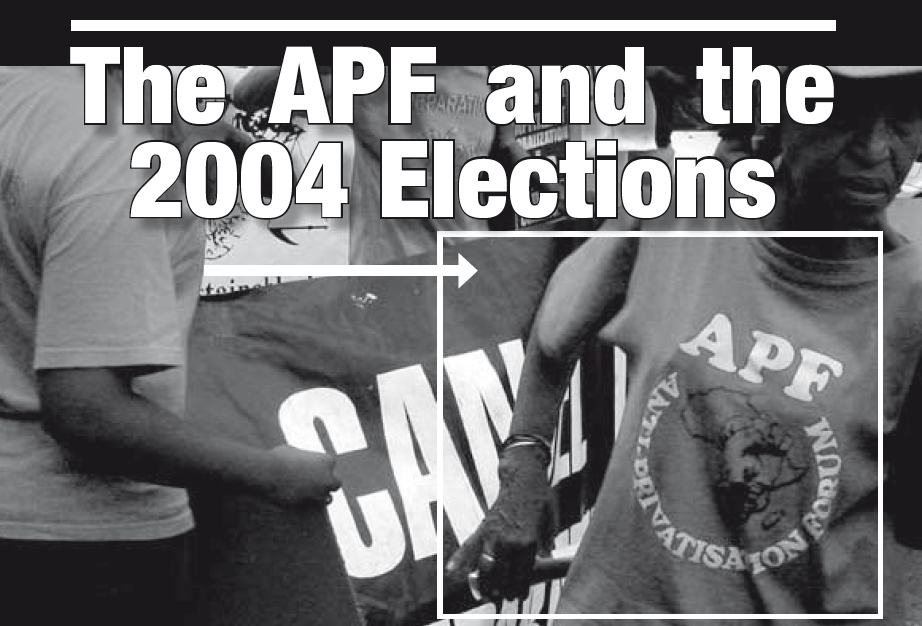
Nina Benjamin* argues that the debate on the 2004 elections within the APF Gauteng contributes to the debate on strategies and tactics in building revolutionary movements.
April 14 looms, and while it is a fait accompli that the ANC will be the majority party, the elections pose important questions for the emerging social movements. In the past few months the Anti- Privatisation Forum (APF) has been engaged in intense political debate on the role of parliamentary elections in building a working class political alternative to the ANC.
In a series of workshops and meetings, members of the more than 20 APF affiliates in Gauteng and North West debated the APF’s attitude to national, provincial and local elections. For the younger APF cadre entering community struggles in the post 1994 period, the experience of ANC parliamentarianism has been one of corruption, nepotism and privatisation. The identification of the ANC as a bourgeois party that has betrayed the interests of the working class was a sentiment that permeated the elections discussions. A call by a minority within the APF to vote ANC as a propagandistic attempt at holding the ANC accountable to its working class supporters was resoundingly defeated. The view of the majority of APF affiliates is that the ANC has crossed the class line, and has become a bureaucratic shell where there is no longer any space to shape its policies and political action.
The experiences of ANC rule in the past ten years played an important role in shaping the APF’s discussions on parliament as an institution of the capitalist state. The generally held view was that parliament is often used for the purposes of “fooling us” into believing that through voting we exercise real power. For a small minority within the APF this meant boycotting parliamentary elections on principle while the majority agreed that participation could allow for tactical gains e.g. increasing the exposure of the ruling classes, raising one’s political profile and gaining access to resources that would be used for the building of a revolutionary movement. There was consensus that parliamentary elections would always need to be subsumed to mass struggle.
No to participation
Having agreed that participation in elections offers tactical gains, the APF then debated whether or not to participate in the 2004 national elections. Three key reasons for not participating as the APF were identified:
- The APF is very mindful of the fact that a large section of the working class sees political parties participating in elections as opportunists and careerists. To prevent being tarred with the same brush, the APF has yet to prove its credentials to significant sections of the working class.
- The APF is a relatively young organisation and participation in national elections could divert its limited organisational resources from mass mobilisation to the bureaucratic procedures required by the elections process e.g. raising funds for registration.
- The APF is in the process of building and developing organisational arrangements and policies to ensure internal democracy and accountability. Developing mechanisms of political control that would keep parliamentarians accountable is therefore still in its infant stages. This is especially relevant in the context of an election system that is based on proportional representation and that allows for floor crossing.
What does this all say about the APF as a political alternative? The APF is a young, dynamic organization that is faced with a range of challenges. Through the debates on the elections a number of challenges emerged.
Firstly, within the APF there exists a range of political histories, theories and experiences. For example, there are community organizations who have participated in local government elections, there are those who believe the APF should participate in the national elections, and there are those who believe parliamentary elections should be boycotted on principle. Some even argue that voting for the ANC will provide the APF with the political leverage to continue pressurising the ANC. As an organization the APF needs to keep the democratic space open to allow for all these different views to be discussed, while at the same time providing leadership and clear positions to those who support the organization.
Secondly, besides different views within the APF, affiliates also have different structures and forms of representation. Some of the affiliates are like the traditional civic movements with clear constitutional structures. Other local affiliates act as a broad front for a range of community structures like cultural groups, income-generating projects etc. These broad front-like structures makes centralised decision making very difficult. Other affiliates are relatively small groups of activists who engage with the broader community through campaigns and mass actions. These affiliates have as yet not managed to involve significant sections of the community in on going organization-building processes.
The different organisational forms under the APF umbrella in many ways reflect the struggle of militants to create political alternatives to the corrupt and ineffective ward committees. The key issues bringing APF affiliates together is the fight against different forms of privatisation and the importance of mass struggles. While a common identity exists, the different organisational forms and experiences of struggle can make centralised decision making difficult.
The impact of these diverse organisational forms and diverse political experiences can be seen in the fact that while denouncing the 2004 elections as bourgeois, APF affiliates did not take a common and binding position on what to do on April 14. The APF did not make a call to boycott the elections, to spoil the ballot or to vote for any of the opposition parties. Effectively affiliates will take that decision on their own.
Significance of the elections debate
In conclusion, the elections have assisted in the ongoing debate about the different strategies and tactics involved in the building of revolutionary power. The elections discussions has also assisted APF cadre in engaging in a sober assessment of the social weight of the APF at this stage of its development. Most importantly within the APF there now exists a clear analysis of the betrayal of the ANC and it’s bourgeois character. So if we ask the question: “Is the APF a political alternative?” then we could answer by saying, “yes, it represents the beginning of an alternative”
*Nina Benjamin is an activist in the APF and works at Khanya College.
Leave a Reply
You must be logged in to post a comment.