
SCLC provides a report of the United Front meeting in the Southern and Eastern Cape
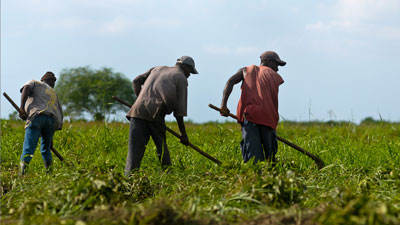
On 14 February 2009, as part of the ongoing debates, farm communities from across the Southern and Eastern Cape met in Graaf Reniet and Oudtshoorn to discuss an approach to the elections. Present at the meeting were emergent farmers, small scale food producers, forestry communities, state land communities, Transnet communities, farmworker formations, restitution claimants, farm dwellers and workers, small rural settlements and Cosatu.
Each sector started off by identifying issues which affect them and existing mobilisation / organising strategies. Common issues which emerged included non delivery of basic services and housing, access to land and the poor quality of redistributed land, evictions, lack of integrated state support for rural development, low capacity and non delivery of municipalities, lack of post settlement support or access to markets for agricultural producers, unemployment in rural areas and poor conditions of employment on farms and councillors who “lie”.
When people considered how these issues had been addressed over the past 5 years since the last national election and what progress had been made, it was clear that there had been no progress, and that conditions were the same, or had deteriorated. The root causes of the struggles were identified as being the neoliberal policies of the state, the poor implementation of these policies, resistance of private land owners and farmers, lack of political will especially of municipalities and an absence of a mobilised sector. What is apparent is that the political parties continue to make empty promises.
Khanya College comrades at the meeting gave a broad overview of the current political and economic environment – both international and national – and how this affects the issues and struggles of the poor.
- Overview of the economic melt down based on the capitalist vision of accumulation of profits and including a critique of the South African government’s response [denial] of the economic crises. What is apparent is that the struggles of the poor will be scaled up with more job losses and increased poverty.
- There is an absence of a co-ordinated national voice of the poor as organisation is generally localized and weak in nature.
- There have been limited changes over the last 5 years. If we take land reform as an example – it was said that 30 % of agricultural land was to be redistributed to black people by the end of 2000. The deadline was then moved to 2014 and then moved again to 2024. The goal stayed the same but the timeframe was just extended every time it became clear that the goal would not be reached within the existing timeframes. We have to look at why deadlines have not been met.
- New political spaces are apparent in the post Polokwane era and with the split in the ANC including the birth of COPE. It is important to asses the various political parties carefully, what do they say and do. The root causes of people’s struggles are common:
- The market based, neoliberal policies
- Lack of skills of officials
- Poor leadership, corruption and nepotism
- Capitalism and the resulting poverty
It is important to critique the policies of the various political parties and see if they share the same analysis. What is apparent in the various party manifestos is that all parties support capitalism, investment and the growth of big business.
- The budget of the country is important. Apart from being a financial plan, the budget of a country can be seen as the country’s policy statement since it gives an indication of what the country sees as a priority and what the country plans to do for the next financial year. In the budget for the financial year 2009/2010, an amount of only 1,8 million has been budg- eted for rural development. This is evidence of the fact that rural development, i.e. the issues confronting those present at the meeting, is not a priority of government in terms of the budget. The fact that all political parties agree with and are satisfied with the budget gives us an indica- tion that rural development is not a priority to them either.
- In the light of the above poor people need to take this opportunity to organise themselves around their issues. Towards this end there are discussions of all the movements around a United Front which would maintain the in- dependence of the movements but link on a national scale towards the defeat of capitalism. The objectives of the United Front would be to defend the working class against the onslaught of capitalism – the accumulation of wealth by the bosses and the effects of the financial crisis. This meeting was not a platform to make deci- sions and it was not the purpose of the United Front to create another government / organisa- tion / political party or to support a particular political party. The purpose of the meeting, and of the United Front, is rather to conscien- tise people around the current state of affairs / issues that are affecting the lives of each and every South-African citizen and also to build solidarity to the struggles of one another since the issues that are confronting the various sectors are more or less the same – we are all confronted by common issues and have com- mon problems and needs.
- The United Front has discussed a number of strategies as to how to keep the issues of the poor in the forefront in the forthcoming elec- tions and express dissatisfaction with the non- delivery to date:
In response to the above presentation, participants at the meeting agreed that:
- There were lessons to be learned from Operation Khanyisa
- The economic crisis will definitely have devas- tating effect on the poor as well
- With 2009 election being in less than 2 months – what is to be done: Boycott elections vs Spoiled ballot
- The immediate task of all present was to engage communities and get a general feeling
- Movements must use up coming elections to raise political consciousness of the people
- Debate would continue within the ranks of the working class.
Conclusion
Participants agreed to discuss the idea of the United Front and how to keep the issues on the table within the elections with their constituencies.
Leave a Reply
You must be logged in to post a comment.