
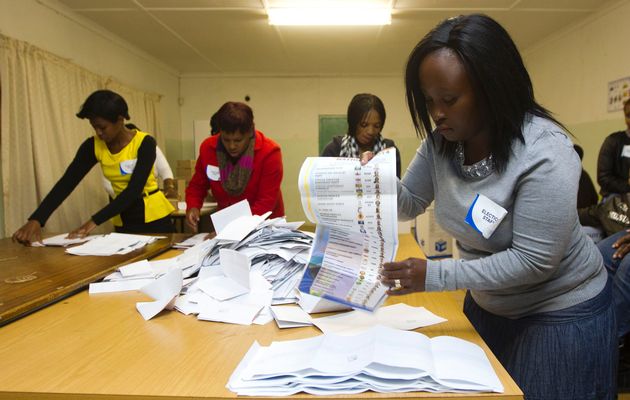
Lebo Manganeng reports on the elections united front meeting in Grahamstown
South Africans go to their fourth poll on 22 April 2009. As political parties hit the road again on campaign trail, the issue on the minds of many voters will be whether promises being made are empty promises or not. This election takes place at a crucial time with many jobs being lost mainly due to international markets slump, threatened food security, growing inequalities and failure of the government to deliver on its promises around service delivery, poverty eradication, land reform, etc.
The East Cape Agricultural Research Project (ECARP) together with Khanya College organised a meeting with farm workers, farm dwellers and small-scale farmers in Grahamstown on 15 February 2009 to discuss what the upcoming elections mean for the rural poor in particular. This session is broadly part of the debates that have taken place since late 2008 by different organisations referred to as the United Front. Within this grouping there is a generalised view that the political parties that are taking part in the elections have no serious intentions of transforming the South African society. The ruling party and all major opposition parties have embraced neo-liberal policies which have, in the past fifteen years, further impoverished the majority while at the same time enriching a very few.
The farm workers, farm dwellers and small- scale farmers who were part of this gathering have organised themselves into networks. The farm workers and dwellers have formed farm committees on 48 commercial farms within the municipalities of Makana, Ndlambe, Sundays’ River, Nkokobe and Nxuba. These farm committees have, to varying degrees, managed to self-enforce labour rights as well as improving their tenure and living conditions.
The first role played by a farm committee is to build solidarity among all farm workers and dwellers. The members of farm committees have, through ECARP, gone through a series of information sessions including different legislation affecting farm workers and dwellers, awareness and consciousness-raising. Farm committees in eight different areas have joined together to form area committees. these structures have also begun lobbying government to address socio-economic conditions on commercial farms. For instance, in 2005 farm workers marched to the Department of Labour offices in Grahamstown wherein the department was petitioned for improve services in terms of enforcement of legislation.
They also embarked on another march against various governmental departments and presented a list of demands. Among other things, they were protesting against the slow pace of land redistribution, non-existent basic services to farm workers and dwellers, and general lack of responsiveness of the government to the needs of farm workers and dwellers. Likewise small-scale farmers have also formed their own collectives and have through these collectives managed to lobby the government, in particular the Department of Agriculture for post-land transfer support. These engagements have equipped these groupings with the ability to critically engage on issues and have through this process gained confidence to take up issues with authorities. This can be seen in terms of how participants at this meeting were able to raise issues and participated in a robust debate. They were able to rise above party politics and engage issues and pointed out the government’s failure even though a number of them are active members of the ruling party.
At the 15 February meeting, participants grouped according to their areas and in a group work were given two issues to discuss: 1) five very important issues that were promised but never met in the last five years and why there has been failure to meet these promises, 2) whether voting again will lead to a fulfilment of promises that were made during the previous elections.
The following issues were listed by the groups as the government failures:
- Land redistribution and the government’s failure to impose a moratorium on buying of land foreigners as demanded by the people.
- Minimum wage that the government decides on its own without consulting farm workers and lack of enforcement of labour laws.
- Poverty relief projects that municipalities start but never go anywhere, and monies that are allocated for development purposes in rural areas but never see results.
- Clinics and schools on farms.
- Housing, sanitation, electricity.
- Transport for school children and for commuting to town.
- Unemployment
- Post-land transfer support for small-scale farmers.
Overwhelmingly people had no hope that the upcoming elections will bring any change. They felt that the government has done little for the majority of the people who have kept it in power and will continue doing so. One group commented that:
“We have no hope because it is now 15 years of representatives filling their stomachs and those of their families. We are saying we cannot put them in office only for them to not even greet us but also show off their cars with wheels at the back (4X4s). However if we could meet together with other non-governmental organisations, build solidarity and speak in one voice, government might listen”.
Comrade Oupa Lehulere of Khanya College gave a brief presentation on what the coming election mean for the majority. The neo-liberal framework that has been embraced by the ANC government denies the government an opportunity to carry out meaningful transformation of South African Society. Failures of the government like the land reform and provision of services can be blamed on the Growth Employment and Redistribution (GEAR) strategy that was adopted by the government in 1996. The 2009 Budget reflects how the government does not take the situation faced by the poor people seriously. For instance just over a billion Rands is to be spent on support of small-scale farmers while a lot more is to be used in preparation for the 2010 world cup.
The people were given an opportunity to respond, and they were generally angered by the fact that they continue to live in poverty after 15 years of freedom. There was recognition that farm workers belong to the working class and there is a need to organise, build solidarity and challenge the government and the capitalist class in general. Different methods of struggle were suggested including work stoppage ranging from one to two weeks, not voting as ‘the vote benefits the rich’, etc.
Participants felt that organisations like ECARP have ‘removed blinkers’ from farm workers eyes and as a result they have managed to achieve things like provisions of labour laws. However, they say:
“it is upon us to take steps to overcome suffering. We must vote for ourselves.” The collective structures have resolved to continue with this debate and building solidarity. There is however a need to build solidarity with other organisations of the poor in urban areas, villages, etc, in order to ensure that there is a strong united voice.
Leave a Reply
You must be logged in to post a comment.