
In this article, Mondli Hlatshwayo argues that adhering to principles defines the operation of democratic working class organisations and movements
Principles are the foundation of an organisation. A strong building is built up on a solid foundation. If the foundation is weak, then logically, the building would collapse. Principles are also considered the “soul” of an organisation and not negotiable.
For example: an organisation that has non- sexism as one of its principles cannot tolerate sexism just because a certain section of its membership believe in sexism. Of course, an organisation that has non-sexism as one of its principles has a task of deepening an anti- sexist perspective among its members. That is why educational programmes are important in deepening the understanding and the underlying philosophic principles.
In our organisations, principles are captured in constitutions, policies, codes of conduct, and procedures. Principles have to be consistent with the “world outlook” or the perspective of the organisation. Principles of capitalist organisations differ from those of working class organisations because these two types of organisations have divergent perspectives. Capitalist organisations are driven by a profit motive which is based on transferring the wealth from a majority to a minority. In other words, wealth is transferred from its producers – the proletariat – to a tiny minority of capitalists. Consistent with this “world outlook”, capitalists tend to have hierarchical structures that operate undemocratically and secretively. The secret nature of capitalist organisations usually gets revealed in the public domain in the form of corporate scandals and corruption.
One of the more recent concrete examples of corruption, lack of transparency and secrecy in capitalist organisations is the Enron Corporation scandal in the United States of America. The Enron scandal was a financial scandal involving the Enron Corporation and its accounting firm Arthur Anderson, which was revealed in late 2001. After a series of revelations involving irregular accounting procedures conducted throughout the 1990s, Enron was on the verge of bankruptcy by November 2001. A rescue attempt by a similar, smaller energy company, Dynegy, was not viable. Enron filed for bankruptcy on 2 December 2001. Enron’s plunge occurred after it was revealed that many of its debts and the losses that it had suffered were not reported in its financial statements. The scandal caused the dissolution of Arthur Andersen, which at the time was one of the world’s top five accounting firms. In contrast to capitalist modes of organisation, the mission of working class organisations is to struggle for the attainment of an egalitarian, democratic and just society. Those who are struggling for an egalitarian society have to be opposed to all forms of oppression and discrimination, including discrimination based on sex, race, creed, sexual orientation and nationality. Additionally, they oppose injustice even if it happens in far away countries like Burma, Iraq, Palestine, Sudan, and so on. Those who are opposed to all forms of injustices also believe that the oppressed are their own liberators. This brings us to an important principle of self-emancipation.
The Principle of Self-Emancipation
The principle of self-emancipation was spelled out more explicitly by Karl Marx in 1864. Marx was the first major socialist thinker to make this principle a fundamental aspect of the liberation project. As he wrote in the statement of aims of the First International Workingmen’s Association: “The emancipation of the working class must be conquered by the working class themselves”, meaning that the liberation of the working class can only happen through the self-mobilisation and self-organisation of the working class itself.
Guerilla tactics and acts of terror and sabotage often tend to undermine the principle of self- emancipation. These acts, because they tend to be carried out by a few people and are often secretive, tend to undermine the principles of accountability and democracy.
The first instance of guerrilla tactics occurred in 1867 when the Fenians, or the Irish Republican Brotherhood (a revolutionary secret society dedicated to the emancipation of Ireland) used tactics of terror to attain the liberation of Ireland. While Marx and Friedrich Engels fully supported the emancipation of the Irish working class, they saw these acts of terror as acts that undermined solidarity between the English and the Irish working class. Their argument was that the solution to the Irish question was the class struggle and solidarity between the Irish and the English working classes. In the Russian context, in the 1900s, socialists such as Vladimir Lenin were also opposed to these methods of guerrilla struggle because they tended to undermine the principle of self-emancipation. Their perspective and belief in the Russian masses and their perseverance was vindicated in 1917 when the Bolsheviks led the Russian popular revolution which installed the Soviet as a form of democratic rule. These gains were reversed as the Stalinist regime began to entrench terror and the brutal suppression of Russian organs of popular power.
Democracy in organisations
Another important principle of working class organisations and struggle movements is that a democratic and a collective society will have to be based on the fullest possible democracy. Marx made this point clear in his earliest writings. But it was only with the workers’ revolution in Paris in 1871, which established the short-lived Paris Commune, that Marx came to see some of the forms that a workers’ state and democracy, would take.
In March of 1871, the army of France admitted defeat at the hands of Prussia. Fearing a Prussian take-over of France, the workers of Paris rose up and took control of their city. For more than two months, the workers ruled Paris before their uprising was drowned in blood. In order to secure their rule, the Parisian workers took a series of popular democratic measures. They suppressed the standing army and replaced it with a popular militia; they established the right of the people to recall and replace their elected representatives; they decreed that no elected representative could earn more than the average wage of a worker; they instituted universal male suffrage and universal education. Those who continue to struggle for working class democracy support the principle of democratic society and self-rule, and see the Paris Commune as a form of rule which encapsulates the principles of self-rule and equality. In other words, the Paris Commune is seen as an alternative model of democracy and emancipation.
Democratic centralism
What are the principles that are supposed to guide decision-making in working class organisations? “Democratic centralism” is the name given to the principles of internal organization used by Leninist political parties or organisations, and the term is sometimes used as a synonym for any Leninist policy inside a political party or organisation.
The democratic aspect of this organizational method describes the freedom of members of the political party or organisation to discuss and debate matters of policy and direction. But once the decision of the party is made by majority vote, all members are expected to uphold that decision. This latter aspect represents centralism.
Leninist organisations’ constitutions have typically defined the following key principles of democratic centralism:
- Election of all party organs from bottom to top and systematic renewal of their composition, if needed.
- Responsibility of party structures to both lower and upper structures.
- Strict and conscious discipline in the party—the minority must obey the majority until such time as the policy is changed.
- Decisions of upper structures are mandatory for the lower structures.
- Cooperation of all party organs in a collective manner at all times, and correspondingly, per- sonal responsibility of party members for the assignments given to them and for the assign- ments they themselves create.
Of course, there is often a debate on democratic centralism. Some may argue that it leads to the dictatorship of upper structures to lower structures. Another possible conundrum is what occurs if the upper structures veer away from the founding principles of the organisation?
Why is democracy so important in organisations? “The means determine the end” is what is often quoted by anarchists when debating organisational questions. The argument is that an organisation that is fighting for democracy and popular participation has to be democratic in its day-to-day functioning. It is often argued that an organisation that is undemocratic will not lead to the attainment of democracy and popular participation. This is why it is important to continue to debate and discuss democracy in our structures.
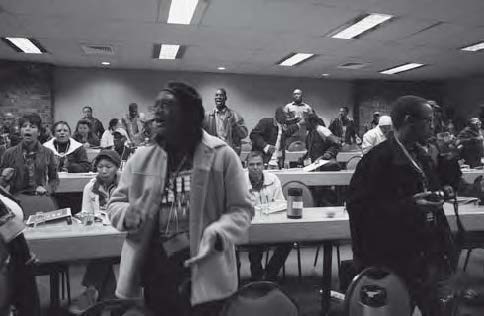
Consistent with the principle of democracy is the question of membership control and active participation of members in the organisation and campaigns. Members have to participate in collective leadership, the regular election of office bearers, report-backs, mandates, debates and decision-making in an organisation. During the session on principles of organisations at the Winter School, some comrades were concerned about organisations turning into a “one-man” show. This demonstrates the fact that some of our organisations are veering away from the principle of popular participation and membership control. What is worse is that we reproduce unequal power relations between men and women in our structures. This issue was raised by an article written by Modiehi Khuele in the Khanya Journal issue No. 10, pp 42 – 45 in 2005.
In the South African trade union context in the 1970s and 1980s, workers in trade unions used to call the principle of membership control and participation a principle of “workers control” and “democracy”. The democratically elected shop steward model was the crystallization and the embodiment of this principle of workers control. Shop stewards had to act and represent workers based on mandates and report-backs. In cases where shop stewards were unable to act in a transparent manner, they were removed. In some cases, negotiations with the bosses would happen in front of the workers. Report-back meetings during wage negotiations and the taking of mandates were important during these struggles. This model of shop stewards and workers control was replicated in township structures and in student representative councils. The recent scandal with the National Metal Workers’ Union investment company, where the executive earned R150 000 a month, is an indication that the control by members (and the objective of trade unions to defend workers’ rights) has been grossly undermined by union leadership in this country.
Non-sexism and the self-emancipation of women should be one of the foundations of our organisations because of the pervasive oppression of women. Unlike Sikhula Sonke (see articles by Maria van Driel and Ighsaan Schroeder in this edition), a lot of our organisations have not taken the question of women leadership and women’s self emancipation seriously. We still see leadership roles being dominated by men. What Sikhula Sonke has done is to focus on organizing women working on farms, and to obligate male members to sign an agreement that they will not abuse women and children. They have also agreed that two thirds of their leadership would be women.
“Workers of countries, unite.” This call at the end of the Communist Manifesto written by Marx and Engels in 1848 was not just an exuberant refrain. It expressed one of the most vital conditions for the victory of the working class. From its very birth the movement of the working class proclaimed its international class character against the national boundaries which marked the development of the domination of the capitalist class over the proletariat. Therefore, xenophobia and racism should also not be accepted in our organizations as they undermine the principles of international struggle against capitalism and the unity of the working class across borders.
Leave a Reply
You must be logged in to post a comment.