
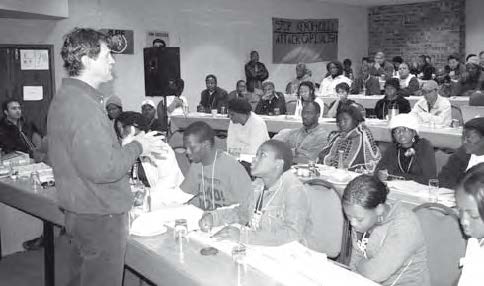
Nerisha Baldevu gives an overview of Winter School 2008
The tenth annual Khanya College Winter School took place from 29 June to 5 July 2008 at the Magaliesberg Conference Centre in Broederstroom. The theme of Winter School 2008 was Organising and Organisation under Neoliberalism.
Context of Winter school 2008
Over the last few years the world has seen the emergence and growth of a global social justice movement. This movement has led to the recognition, by the public and by those in positions of authority, that while the world has unprecedented levels of production of material wealth, the majority of the world’s people are still mired in poverty. Increasingly, and to varying degrees, the poor and marginalized are organising and mobilising to change their lives. The social justice movement that has emerged under neo-liberal globalisation faces many challenges:
- The movements are emerging outside of the traditional working class organizations such as trade unions and civics and are largely single issue-based, isolated and localised in struggles, with no coherent programmatic perspective that guides the organization.
- Many of the activists in the new movements have limited organisational experience. Sustaining levels of mobilisation, organization, and solidarity building within local and global contexts are some of the key challenges facing the new activists.
- The new movements are composed of predomi- nantly the unemployed, informal sector, the self-employed, and most importantly women. This has posed an important challenge i.e. how to deal with the immediate issues of survival at the same time as the movements address the broader issues of social, economic and politi- cal power. The preponderance of women in the new movements has given a strategic and political significance to the issue of gender and social mobilisation.
- As communities have become impoverished the issue of resources for mobilisation for social action has taken on a new significance. It has thus become important to ensure that meager community resources do not become a divisive factor but become a factor that builds solidarity.
To develop political strategies that build and strengthen these movements, it is necessary that the forms of organizing be appropriate to the current context of neo-liberal globalisation and the challenges this poses for the social justice movement.
The aims of Winter school 2008
- To provide the space for activists to critically reflect on their organising and mobilizing work in the present national and global context.
- To analyse the effects of neoliberal globalisation on the working class, and on women particular- ly, and traditional working class organizations
- To assess and analyse the current state of the social justice movement globally
- To explore and debate the role of theory and analysis in organizing under conditions of neo- liberalism and globalisation
- To explore, debate and draw lessons from the organizing models and practices of the social justice movement of the 60s, 70s and 80s.
- To examine different organizing strategies so as identify strategies appropriate to the new social justice movement organizing in the current context.
- To provide activist with the theoretical tools necessary to strategizing in the national and global contexts.
- As part of the 10th Anniversary celebrations of the annual winter school, to raise the profile of Khanya College as popular education institu- tion.
- To build and consolidate links and networks between and among local and regional social justice organizations and organisers
- To provide a platform for the exchange of organ- izing experiences and ideas
Profile of Participants
Due to the nature of the topic, the approach to participation that Khanya adopted in 2008 year was to have a smaller number of organisations with larger delegations per organisation. Organisations targeted to participate in the school were those who were:
- Consciously grappling with the topic, and be- ginning to theorise their struggles;
- Not necessarily conscious of it, but already organising differently;
- An important constituency
There were 110 participants at the school from 53 different organisations, including 19 Khanya College staff. Sixteen of the organisations represented at the school were from North and Southern Africa. Organisations represented included social movements, community based organisations, trade unions and NGOs.
There were 8 countries in Africa represented at the school. These were Zambia, Swaziland, Zimbabwe, Mauritius, Malawi, Tanzania, Kenya and South Africa. Twenty percent of participants at the school came from countries outside South Africa. While 12 of the organisations at the school – both regional and South African – were first time participants to the school, the continued participation of the rest of organisations gave both Khanya and these organisations the opportunity to consolidate links, as well as build new links with organisations involved in similar struggles and facing similar organising challenges. At Winter School 2007, a special session on the participation of women in the school and Khanya events resulted in an agreement between Khanya and the organisations present that:
- All future delegations would have a 50-50 sex representation;
- Organisations that did not meet this criteria would be excluded from the school
- Organisations would hold internal discussions on the issue of gender equity at conferences and meetings
In the run-up to the school, this agreement was enforced, with several organisations needing to revisit their delegations or be excluded. As a result, 48% of the participants at the school were women. While this was a significant increase on the 40% women in 2007, the College aims to have 50-50 participation in future schools.
The Programme
The school kicked off with a plenary presentation and discussion on the importance of organising and organisational questions for the working class in a neoliberal context. This launched the programme of the school, which was designed around six key themes
- Theme 1: Capitalism, the working class and organisation: This theme looked at why and how the working class organises, covering sports clubs, church groups, social groups as well as political formations.
- Theme 2: Capitalism and working class organisation today: This theme focussed on the organisations at the school itself, exploring issues of whom we organise, how and why. The session also looked at the development of these organisations over time, their strengths and weaknesses, as well as their level of implantation in the community in which they organised.
- Theme 3: Principles of working class organisation: This theme asked participants to reflect on the aims and actual operation of their organisations, with the aim of identifying the gaps in what we say and what we do, and ultimately, drawing up a list of principles that should guide how organisations operate.
- Theme 4: Methods for building working class organisation: In three parallel sessions, this theme explored the basic tools for organising, using community radio, print media and theatre. This was followed by parallel sessions on skills training, looking at communication and conflict resolution, and using film as an organising tool.
- Theme 5: Resources for building working class organisation: This theme looked at the issue of resources, what they are, and how we access them. The theme explored these questions through specific areas: Building organisation on an on-going basis; Campaigns and mobilisation; Livelihoods; and the role of NGOs.
- Theme 6: Sector organising and organisational challenges: In four parallel sessions of Labour, Youth, Social Movements and Women, partici- pants looked at the specific challenges to organ- ising and organisations in their sectors.
Throughout the school, participants used various forms of reportback, including roleplay, radio broadcasts, video broadcasts, and presentations. This assisted in building on the basic practical skills of popular education.
The school also produced the daily official winter school newsletter, Imbila Yesu, which provided participants the space to submit articles, as well as be involved in the whole production process. As with 2007, the newsletter was produced in A3 newsprint format, giving it much cleaner, and more professional look. A dedicated media team made up of participants from various organisations who had gone through a training programme prior to the school was responsible for its daily production.
Although Khanya did not repeat the Winter School radiobroadcasts of 2007, the media team did also carry out interviews with participants for the purposes of radio programming, and the production of a DVD. While the less than professional equipment did result in poor quality recordings – particularly with regard to the sound, a DVD has been produced for distribution to participating organisations. The radio recordings will be broadcast on community radios in the near future. The recordings which were played at the school supplemented the school programme, and included interviews with participants from the region and South Africa on organising and organisation. Through this participants got the opportunity to share information and experiences, as well as gain experience in broadcasting.
Evening Programme
The evening sessions of the first three evenings of the school entailed a mini-film festival, with screenings and discussions of films that dealt largely with themes of organising, immigration, and the physical and psychological borders erected by capitalism. Films screened included Bread and Roses, The Bus Riders Union, Lucky Miles and Labour Brokers or Labour Breakers? the Giwusa documentary on organising labour broker workers. The screenings resulted in vibrant and spirited discussions and debates on forms of organising, capitalism, xenophobia and immigration. Other evening sessions looked at, firstly, Women’s organising initiatives – focusing on women in the informal sector in Zambia through the experiences of the Alliance of Zambian Informal Economy Association, and women farmworkers in the Western Cape through the experiences of Sikhule Sonke. Both presenters offered innovative, creative and wide ranging information on organising and organisational forms, as well as the range of issues – which directly affect the membership of these organisations -tackled by these organisations. The second session looked at Organising Immigrants in South Africa, focussing on the xenophobic attacks of May 2008, and questions of how to organise with and within immigrant communities.
Winter School 2008 wrapped on a convivial note with a cultural and dance party on the last evening. The event included performances by local poets and artists, comrades from Swaziland, Kenya and Zimbabwe, as well as drama, song, traditional dance, and finally, a dance party that continued into the early hours of the morning. Winter School 2008 was an important contribution to the growing debates and discussions on the need for the conscious theorising of struggle, the understanding that the way we organize is determined by who we organise, which is determined by the effects of capitalism; the need to understand and experiment with what guides our organising – and how we organise – in this period; and the debate on what the appropriate tools, tactics, principles and elements for organising in this period are. As such, it was a very successful school, and the debates raised in the school will no doubt be continued within organisations.
Leave a Reply
You must be logged in to post a comment.