
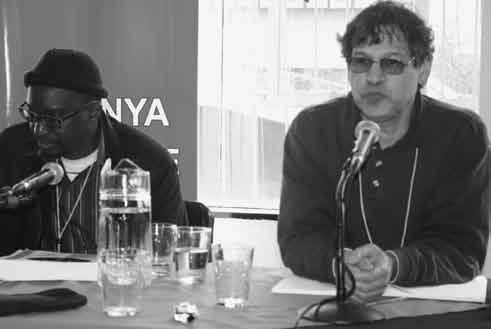
In this article Ighsaan Schroeder* gives an overview of the main activities at the 2009 Winter School and an assessment, including that of participants at the School.
An Overview of the 2009 Winter School
2009 witnessed the 11th edition of the annual Khanya College Winter School. The theme of the School was “Crisis and Resistance”, while its format marked a radical departure from previous Winter Schools.
1. Attendance at the 2009 School
One thousand two hundred and twenty seven (1227) participants from 15 countries participated in the school over the 11-day period. Countries represented were Angola, Austria, Kenya, Lesotho, Malawi, Mauritius, Mozambique, Namibia, Rwanda, South Africa, Swaziland, Sweden, Tanzania, Zambia and Zimbabwe. Participants were drawn from social movements, trade unions, community based organisations, academia and NGOs. Thirty two percent of the School participants were drawn from the other participating countries. A total of 163 activists representing 76 organisations participated in the closed activities of the School. In keeping with the College’s objective of building women’s leadership, Khanya had required 50-50 representation of men and women of all delegations to the school. Nonetheless, we did not manage to achieve this.
Women constituted 46% of the participants. Out of the total of 1227, 665 were men and 562 were women. The skew in favour of men was partly due to the participation of self-funded organisations in the school, but mostly, to the ongoing weaknesses in movements and organisations generally, and specifically on the issue of gender. The College has, however, noted this, and will continue in its attempts at balanced delegations.
2. The Theme: ‘Crisis and Resistance
As the Winter School brochure notes: The global economic crisis brought to the fore the inherent contradictions of the capitalist system. The crisis —“the worst since the 1930s”—has therefore dealt a devastating blow to the international legitimacy of the capitalist system. The free-market nostrums that have been exalted as unchallengeable truths by politicians, media talking heads and many academic economists for more than three decades have been discredited, intellectually and morally. There is growing apprehension among the ruling classes about the future that awaits the capitalist system. The present debate within the ruling class and its political establishment is centered on how the system is to be saved. This is based on the notion that this crisis is the product of circumstances, which – however dreadful in their cumulative impact – are somehow external to the economic system. The cause of the crisis is not to be found in the essential nature of the profit system. Rather, the problem lies in the environment within which it presently operates. Therefore, the debate is on how to reconstitute the same sort of capitalism of the last forty years in a slightly more regulated, benevolent form, and without upsetting ruling class interests and the consolidation of its power.
The operation of the capitalist economy cannot be separated from the class relations and interests to which it gives rise and in which it is embedded. During the past quarter century, the decay of capitalism has created a powerful social constituency, commanding vast wealth, whose social and political arrogance has been magnified by its economic parasitism. If any conclusion can be drawn from its initial response to the bankruptcies and collapses produced by its own policies, it is that the ruling class is determined to make the mass of the population pay for the cost of the crisis. The previous crisis of capitalism in the 1970s resulted in the rebirth of capitalism as neoliberalism. Over the last 40 years, neo-liberalism has fundamentally reorganized the world, and fragmented the working class. In the workplace, the extension of the working day, increased mechanisation, unemployment, multi-tasking, casualisation and the general feminisation of labour have cut across all industrial centers. With this, the room for dividing workers has expanded: permanent workers alongside the casuals who are employed on a daily basis, or employed by a labour broker, contract workers employed for a defined time, an increase in undocumented workers, and the feminisation of these jobs, pitting men against women, both in terms of employment and wages. Against this backdrop there is also the rural unemployed and the informal economy.
With the current global economic crisis, an already battered working class will now carry the burden of that crisis if the ruling classes simply reconstitute the capitalist system. Already the working class is facing mass retrenchments, housing evictions and increased poverty. Without mass organisation and mobilisation with appropriate strategies, the working class and poor will be further marginalised. Winter School 2009, with the overall theme of Crisis and Resistance, provided a platform for the analysis of the current context, and the debate and discussion of appropriate strategies to challenge the system, and strengthen mass organisations of the working class”.
3. The Format
The concept and format of the 2009 Winter School marked a radical departure from previous Winter Schools. The change resulted from extensive assessment of the impact of previous Winter Schools, which highlighted 3 major problems. The first was the limited number of activists the Schools typically reached. The second was that not all Khanya programmes contributed equally substantially to the event. The third was that the School did not enjoy any public profile, further limiting its impact. To address these 3 major problems, the School has been reconceptualised as an educational festival incorporating a number of open and closed events, spread across different venues in the Johannesburg inner city. It was hoped that through this format, a far greater number of activists could attend the activities of the School, the different College programmes could all integrate School activities into theirs, and that the School would attract a much higher public profile. The latter would be assisted with important new activities added to the School, such as the Jozi Book Fair. The School would still draw a core of around150 activists as in previous years, who would continue to have a national and regional mix, but this core would now be supplemented by activists from local organizations who were free to attend activities on a daily basis over the 11 days of the School. In addition, the College could now target constituencies whom it has not had much contact with in recent years, such as students, as well as broadly sympathetic elements from within cultural and leftist groupings, interested mainly in particular events such as the festivals or fairs. Also, the School’s inclusion of a larger number of cultural activities in particular would allow it to forge new partnerships and links with a range of progressive organizations. The 2009 Winter School educational festival included a conference on radical political economy, a public address on the global economic crisis, cultural festivals including theatre, film, poetry and music, an exhibition, an NGO fair and a Book fair, meetings of networks of resistance and a number of skills for resistance workshops.
4. Participants’ Assessment of the 2009 School
Participants’ views on the School were canvassed through written assessments, interviews and subsequent telephonic interviews. Most concurred that the School had been very successful in its primary objectives. Moreover, in its new format the School was more flexible, allowing greater participation by more organizations and giving individual participants greater freedom to choose activities they were most interested in. Some participants who had participated in previous Schools, while happy with the new format, felt that the 2009 format did mean losing some of the intimacy of the old format, but that this was not decisive in their appreciation of the School.
Nomkhosi Sangweni of Katlehong Concerned Residents commented:
“As an activist this school created a platform for us to have a say and learn more about our social movements, our struggles as well. The interaction with other comrades from other countries was also very challenging and I realize just how we all have same issues that we face in our countries. It was very educational, refreshing and challenging as well.”
Zama Dube from the same organization:
“I just want to add that as a young woman who somehow has not been exposed so much into our struggle against these capitalists, I am now not afraid to stand my ground and say ‘NO’ to any form of exploitation….The xenophobia network meeting I attended has made a great impact on me as an individual and a leader. It gave me a chance to interact more and have a better understanding of the other comrades from the other countries. Also how we should find a way to accept, love, welcome or even find a way to understand and tolerate each other even though we are from different countries.”
5. Khanya Assessment;
The School in Context
The School undoubtedly achieved many of its primary objectives, as confirmed by the participants’ evaluations. However, it is equally clear that the School itself reflected the current weak state of working class organization. Both the Thursday and Friday of the Conference on Radical Political Economy were marked by a relatively quiet mood, with the discussion and debate dominated by the presenters and representatives of NGOs more familiar with the subject matter. By the time of the public debate on the Saturday there was much more participation from the social movement activists themselves, although at this stage much of the discussion focused on the relatively weak state of the social movements and the trade unions. Not much discussion and debate centred on the global economic crisis, although the panelist from Zimbabwe in particular had to field quite a number of questions about how this fresh crisis was impacting on an already critical situation. But there was a definite upswing in participation and mood. By the time of the plenary discussion of the Networks on the Monday morning there was a noticeable shift in the level of participation around the specific issue of the global crisis. This was observed also in the network meetings themselves and again in the closing plenary on the Friday afternoon. The shift can be explained not only by the Saturday public discussion but also by the cultural activities over that weekend. The cultural activities were also organised under the theme of ‘Crisis and Resistance’ and undoubtedly contributed towards further clarification of some of the issues related to the global economic crisis. As Francine Umurungi, one of the participants from Rwanda, states:
“Personally I was amazed to see how the young people are mobilised against imperialism, and ready to fight for real liberation. This was mainly visible in the Words in Action and Theatre festivals.”
The Changed Format
The School also managed to address the problems that necessitated a change in format. 1227 participants were active in various School activities, compared to an average of around 150 in previous Schools. This is a dramatic increase in number. Second, all Khanya programmes hosted various events. This too marks a significant departure from previous experience, where the School became the responsibility of one or two programmes and a small handful of Khanya staff. Third, the School received significant media exposure, unlike in the past. This included coverage on TV, radio and in the commercial press. However, much of this coverage was confined to the various cultural events, such as the theatre festival and book fair. The deliberations of the conference on radical political economy, for example, got almost no media coverage. There is thus still much work to do in how the College positions the School in the public domain. The changed School format impacted dramatically on organizing and logistical questions on a number of levels. For example, whereas the old School format made invitations a formality, under the new format with its combination of open and closed events this relatively simple task became a headache, necessitating face-to-face meetings with participating organizations, rather than the mere extension of an invitation. The new format was also being tested out in a context where the majority of the Khanya staff in 2009 had themselves never participated in a Winter School of any kind before.
The experience of organizing a School was thus brand new to many of the organizers themselves. In this context the School was a challenge to the College but one that can lead only to a more impressive School in 2010.
Leave a Reply
You must be logged in to post a comment.