
Salim Vally* and Yasmin Sooka* argue that Edward Said’s unswerving commitment to the Palestinian struggle for dignity and justice was located within a much greater struggle for a truly universal and humanist vision,
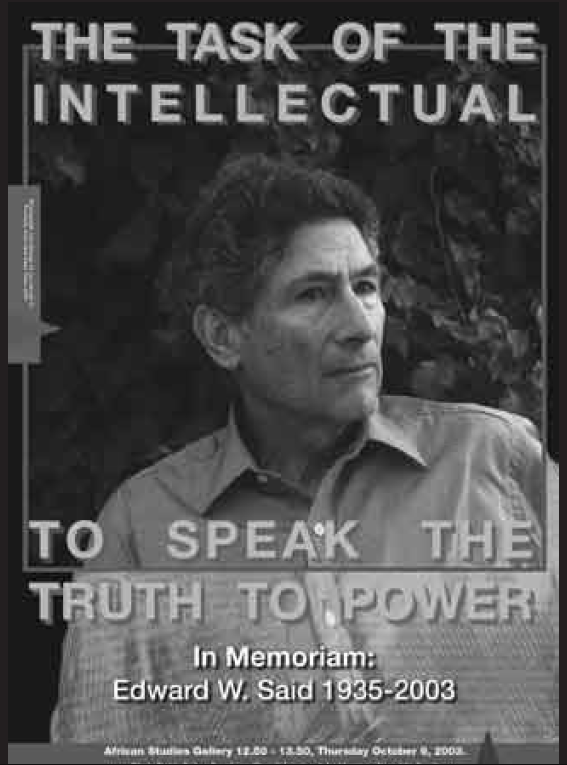
“Nothing in my view is more reprehensible than those habits of mind in the intellectual that induce avoidance, that characteristic turning away from a difficult and principled position which you know to be the right one, but which you decide not to take. You do not want to appear too political; you are afraid of seeming controversial; you need the approval of a boss or an authority figure; you want to keep a reputation for being balanced, objective, moderate; your hope is to be asked back, to consult, to be on a board or prestigious committee, and so to remain within the responsible mainstream; someday you hope to get an honorary degree, a big prize, perhaps even an ambassadorship.
For an intellectual these habits of mind are corrupting par excellence. If anything can denature, neutralize, and finally kill a passionate intellectual life it is the internalisation of such habits. Personally I have encountered them in one of the toughest of all contemporary issues, Palestine, where fear of speaking out about one of the greatest injustices in modern history has hobbled, blinkered, muzzled many who know the truth and are in a position to serve it. For despite the abuse and vilification that any outspoken supporter of Palestinian rights and self-determination earns for him or herself, the truth deserves to be spoken, represented by an unafraid and compassionate intellectual.” – Edward Said
In paying tribute to one of the most forceful public intellectuals of our time, the Palestine Solidarity Committee and the Wits University Education Policy Unit used the quote above to advertise the well-attended memorial meeting held at Wits University on October 3rd. The Memorial titled ‘Appreciating Edward Said’ showcased the breadth and richness of Said’s writings.
There are few fields of intellectual endeavour that are untouched by Said’s contributions. A prolific and path-breaking scholar whose writings attempted to transform the humanities and social sciences, Said’s impact and engagement went beyond the academy. He was also an activist who worked courageously for justice and fearlessly spoke truth to power.
Above all, Said will be remembered for his unswerving commitment to the Palestinian struggle for dignity and justice. He located this cause within a much greater struggle for a truly universal and humanist vision, and a rejection of ethno- nationalism and religious fanaticism. Said taught by example that being faithful to a cause did not mean blind loyalty to leaders or symbols but necessitated self-criticism and debate. His engagement with the Arab world and his fierce criticism of its status quo, including his attacks against the corruption of the Palestinian Authority, was equal to his passionate expose of Western Imperialism and its apologists.
The EPU/PSC programme featured the following speakers: Sipho Seepe, Yasmin Sooka, Ashwin Desai, Jane Duncan and Prishani Naidoo. Messages from the cartoonist Zapiro (Jonathan Shapiro), Minister Kader Asmal and Said’s friend, the famous musician and conductor, Daniel Barenboim, were read out. Khanya College, the PSC and other organisations have agreed to hold an annual Edward Said Memorial Lecture. A booklet that includes the various speeches mentioned above will kick-start the initiative. We print below a contribution by Yasmin Sooka.
Extracts from the tribute to Edward Said by Yasmin Sooka
Edward Said has been described as a towering intellectual in the literary field and in the field of cultural studies, particularly as a writer on Palestine. Many do not know that he was a wonderful pianist as well.
In a time when the Arab world and Islam particularly were misrepresented in the world, his wonderful work ‘Orientalism’ challenged the Traditional western notions of both the Middle East and Islam.
He also paid several visits to South Africa. While we remember him for his intellectualism, in the human rights community we remember him for his passionate commitment to issues of truth and justice, particularly for Palestine. Edward Said himself was a Palestinian whose family was forced to flee their home in Jerusalem after the occupation of Palestine in 1948. Himself a lifelong exile, and having experienced the dispossession of land and home, he devoted himself to writing passionately about the Palestinian cause. The beauty of his work was the location of this struggle in the international struggle of all peoples to be free of the hegemony of the new world order.
Edward Said was committed to being a witness to the truth. He was nobody’s lackey and never allowed himself to be manipulated, bearing witness to the truth even when it was unpopular, earning himself hatred from both sides because of his unswerving commitment to truth. Journalist Robert Fisk wrote that Edward Said ‘spared nobody’. Said was critical of both the Palestinian Authority and the corruption that had become manifest in it, and even more scathing of the Israelis and Ariel Sharon. He was harsh in his critique of both the Oslo Accords and the White House agreements. Shortly after these ‘peace’ agreements were signed, Said gave an interview, saying: “The actual ceremony itself, if one watched it, and I did – I had been invited but refused to attend because for me it wasn’t an occasion of celebration but an occasion for mourning – it was, I thought, quite tawdry. In the first place there was Clinton, like a Roman emperor, bringing two vassal kings to his imperial court and making them shake hands in front of him. Then there was the fashion show parade of star personalities brought in. Then, and most distressing of all, were the speeches, in which Israeli Prime Minister Rabin gave the Palestinian speech, full of the anguish, Hamlet’s anxiety and uncertainty, the loss, the sacrifice and so on. In the end, I felt sorry for Israel. Arafat’s speech was in fact written by businessmen and was a businessman’s speech, with all the flair of a rental agreement. It was really quite awful. And since he didn’t even mention anything about the sacrifices of the Palestinian people, didn’t even mention the Palestinian people in any serious way, I thought therefore that the occasion was an extremely sad one. And it seemed to me therefore, that his speech, the occasion, the ceremony, and so on, seemed to be completely in keeping with the contents of the agreement, which themselves also make the Palestinians subordinate dependents of the Israelis, who will in fact continue to control the West Bank and Gaza for the foreseeable future.”
His words proved entirely accurate. More than 10 years later, Palestine is still not free.
In his lifetime, Edward Said became the voice of the silenced, a voice for the Palestinian cause in a time when that voice is so rarely listened to because of powerful lobby groups. He spoke without hate and appealed to the humanity within all of us. His daughter, Najla, said that from his deathbed he urged that ‘the struggle for Palestine continue’. We owe him that. In South Africa, we are slowly emerging from our obsession with ourselves. The Anti-War Coalition has seen us begin to locate our own struggle for justice within the wider struggle for justice and peace. People like Edward Said have inspired this international solidarity of people, who want to be free. It is important that, in the pursuit of justice for ourselves, we remember the struggle of the Palestinian people, the struggle of Iraq to be free of the yoke of the new world order and their neoliberal agenda, and on our doorstep, the struggle of our comrades in Zimbabwe to live in a just society.
We need to remember that our own struggle to be human is irrevocably bound to recognising the humanity of other peoples too. Hamba Kahle Edward Said, and May freedom and peace come to the land of Palestine for which you have struggled for so long.
Salim Vally* is a member of the Palestinian
Solidarity Committee and is also active in the APF
Yasmin Sooka* works for the Foundation for Human Rights, and was a commissioner in the Truth and Reconciliation Commission.
Leave a Reply
You must be logged in to post a comment.