
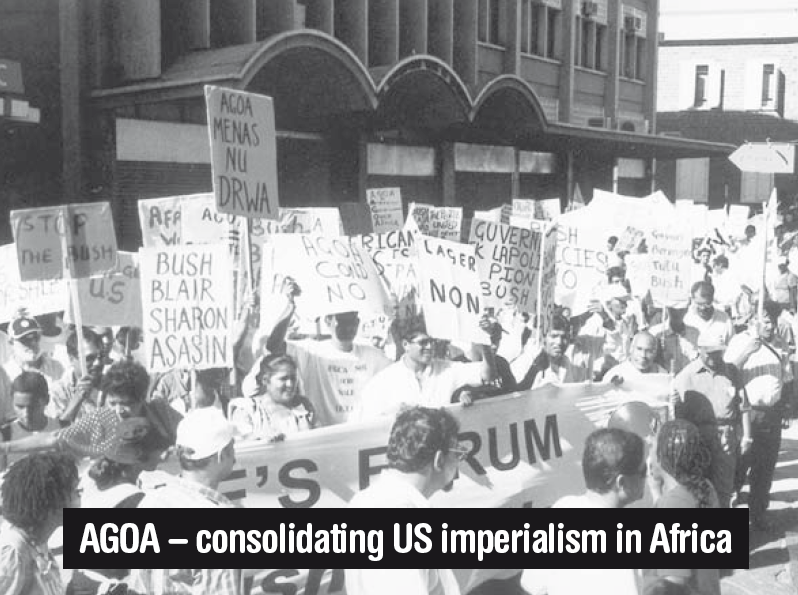
Rajni Lallah* argues that AGOA is aimed a colonising Africa for US capitalists. She also argues that it forms part of the US’s plan to extend its military stranglehold on the continent.
AGOA is becoming an important link to all kinds of events on the political and economic scene in Mauritius.
Privatisation, liberalisation, the passing of a “Prevention of Terrorism Act”, factory closures, delocalisation, oil, militarisation: all these events are connected in one way or another to AGOA. This article explains how and why.
The US has acquired a new colonial device to get African States to submit to US imperialist rule, with the active support of African ruling classes. The
US African Growth and Opportunity Act (AGOA), enacted in the year 2000, gives President Bush king-size powers to decide which African State he will or will not open the US market to. AGOA has many conditionalities that African States have to submit to in order for them to gain preferential access to US markets for their capitalists’ goods and services. At least once every two years, under AGOA, President Bush calls in “eligible” African States to an AGOA Forum to tell them what he thinks their political and economic agenda should be. This colonial performance is what the Mauritian government congratulated itself on hosting the AGOA ministerial forum in January 2003.
An “AGOA business forum” is also being held at the same time as the official “AGOA Forum” in January. At this second Forum US businessmen will be looking for African “brokers” to facilitate their implantation in those African States labelled “eligible” by President Bush. Mauritian capital is eagerly offering itself as the African “broker” for
US multinationals. This is why the Mauritian ruling class has been tripping over its own feet in a hurry to get the AGOA business forum going.
US business and African capitalists see in AGOA growth and opportunity for themselves, and are busy negotiating joint ventures in regions of
Africa where working people have less social and economic rights and where wages are the lowest. In countries like Mauritius or South Africa, there are massive delocalisation plans in process that will downslide wages, working conditions, and social and economic conditions of all the peoples of Africa.
AGOA: its history, aims and conditionalities
AGOA has had many names. These last years, it has been called the Africa Bill, the African Growth and Opportunity Bill, the Africa Act or the Trade and Tariff Act. The voted version is now known as the African Growth and Opportunity Act (AGOA) and is part of a law called the Trade and Development Act of 2000. The US ruling classes have been persistent in pushing through AGOA because it is so central for the US imperialist strategy that dates from the 1990’s. According to the late US Commerce Secretary Ron Brown, “ the United States would no longer concede the African market to former colonial powers.”
This statement by Secretary Brown needs to be linked to an important point concerning the procedure used for establishing AGOA. AGOA is not a multilateral agreement negotiated between the US and African countries. It was unilaterally imposed by the US. It was proposed by the US President and voted in by the US Congress. This US law is a kind of “extra-territorial” legislation, as if Africa was a US colony.
Many African countries in Northern Africa (West Sahara, Algeria, Tunisia, Morocco, Libya and Egypt) do not fall under the AGOA “zone of influence”. The colonial “carving up” of Africa lives on: the US can now, if it is not stopped, establish its own “colonies” in Africa that will be governed by AGOA.
What the US wanted was to implant US multinationals in Africa for them to control the rich natural and mineral resources including oil, gold, copper, diamonds, and for them to get a larger share of the African market. The US refers to this as accelerating Africa’s “integration into the global economy” which would “advance American commercial interests through an invigorated emphasis on trade and investment”. The second US policy goal was to get a firmer military hold on Africa. With President Bush now in power, AGOA has become an instrument that perfectly addresses the needs of his regimes’ aggressive military policies.
The United States government constantly harps on the need for the rest of the world to give capitalism a free rein. In the long-run it wants to transform everything, from goods to services, from water to the land, into commodities that are bought and sold for profit, without taxes, without regulations, without any public or democratic control. This is what it calls the “free-market”. When it comes to its own market, the United States is not inclined to subscribe to “free-market” policy it adopts protectionist policies in the interest of US capitalists that do not want their profit restrained by the entry of cheaper goods and services into the US market. AGOA incorporates these two aspects of US policy: it spreads capitalism, and it protects the US capitalists from competition.
In terms of AGOA, African countries will be granted access to US markets only if they accept conditions set up the US. In AGOA, overt conditionalities are referred to as “eligibility requirements”. Up to now, the US President has “declared” 36 African countries “eligible”, and AGOA “eligibility requirements” are actually being used by President Bush to close the US market to goods and services coming from “non- eligible” African countries. Some of the more important conditionalities imposed by AGOA on African countries are:
AGOA says: “Adopt a ‘market economy’“
One of the conditionalities in AGOA is that African countries must have a “market economy” in order to be “eligible”. This means that the whole economy must operate on a profit-basis. Measures to re- distribute wealth and to restrict class inequality such as taxes on companies must be gradually scrapped until they disappear altogether
AGOA says: “Sell off everything that is publicly owned”
AGOA promotes privatisation of state owned enterprises and services. Even basic services such as health, education, pensions, water, electricity, telecommunications, transport, and other social services must be transformed into “commodities” sold by capitalist business-operations.
AGOA says: “Remove subsidies and eliminate price controls”
Yet another condition is that African States must eliminate subsidies and price controls altogether. This includes subsidies to ensure food security: subsidies on basic food such as rice and flour, subsidies on medicine, on vaccines, on contraception. Subsidies on agriculture for small- scale planters and farmers, subsidies on fishing, on animal farming, subsidies on exports; subsidies that are vital to the lives of many people in Africa will have to be wiped out. Subsidies on export-oriented industry will have to be removed. Price controls, even on basic foodstuffs must also be removed.
AGOA says: “Submit to foreign companies”
AGOA says African States must give foreign capital the same treatment and measures as national capital. Measures such as giving subsidies for local production or putting taxes, duties or tariffs on foreign goods to protect local production will no longer be possible. It also means that governments will no longer be able to pass and enforce regulations on foreign firms that they employ local workers. Governments will no longer be able to limit foreign multinationals repatriating all their profit to their country of origin, and they will no longer be able to stop foreign capitalists from actually buying land. There is now a strong multinational lobby in the US that wants governments around the world to sell them land, particularly where there are precious mineral resources, or oil.
AGOA conditions protect US capitalists
Under AGOA, the US will only open its market to garments made from yarn or fabric produced and assembled in the US or an African country. The US Congress made this concession to US capitalists in the textile sector who saw AGOA as being a threat to the American textile business. The only exception to these “rule “is in the case of” lesser- developed African countries. “Lesser-developed” African countries are defined in such a way that countries like Equatorial Guinea, Gabon, Mauritius, Seychelles, and South Africa are excluded.
AGOA says: “You must follow US foreign policy”
AGOA crudely states that African States, in order to fulfil requirements for eligibility, must not “engage in activities that undermine United States national security or foreign policy interests”. This “conditionality” is real: President Bush has already used it. Burkina Faso has been refused “eligibility” under AGOA partly because it does not ‘promote’ US foreign policy. The US President states that “Burkina Faso has played an unhelpful role regionally, undermining stability and US foreign policy interests”.
Already, Mauritius is feeling the weight of this conditionality. Since the passing of AGOA, the Mauritian government has unconditionally backed the US attack on Afghanistan, has blindly followed the US lead in voting through the Prevention of Terrorism Act, and is now shamelessly poised to support US warlords in aggression against the people of Iraq.
“Growth and Opportunity” for US business
The US, through AGOA, guarantees that the entry of African goods and services into the US market will not cut into US business and profits. For instance, whenever certain African textiles or apparel threatens the US textile industry, the US President can suspend duty-free treatment. African States have to conform to US directives on customs regulations so as to satisfy the US textile companies. Officials of the US can even snoop around in the Customs offices of African countries seeking AGOA eligibility, to check whether they are conforming to US Customs directives.
Not only does AGOA aim to pry open the African market to US business by imposing conditionalities, it also sets up a whole state bureaucracy in the US to assist US multinational implantation in Africa, including through subsidies. In the October 2001 AGOA forum, President Bush had already announced the creation of a $200 million Overseas Private Investment Corporation support facility to give American firms “access to loans, guarantees and political risk insurance for investment projects in sub-Sahara Africa.”
AGOA, Diego Garcia and the US’s global military strategy
In Mauritius, the United States occupies a military base on Diego Garcia (Chagos), an island illegally dismembered from Mauritius by the United Kingdom during independence negotiations in the 1960s. The Mauritian people living there were forcibly removed to the main island of Mauritius and to the Seychelles. The base has subsequently been used to bomb Iraq in 1991 during the “Gulf war”, to bomb people in Afghanistan last year, and is now to be the USA’s main launching pad to bomb people in Iraq yet again. AGOA, and new US policy in Africa has very serious implications for the struggle to close down the US base on Diego Garcia, other US bases in Africa and for the struggle to demilitarise the whole African and Indian Ocean region. In Kenya, for example, the US occupies an air base which was used in the attack against Afghanistan after the 11th of September 2001
Since independence, the struggle for the closing- down of the US base on Diego Garcia and the re- unification of the Chagos with the rest of Mauritius has often been used by the Mauritian State as a negotiating point for “trade” on behalf of the Mauritian capitalist class. This sordid deal has now become “institutionalised” in AGOA: the Mauritian State’s silence on the closure of the US base in return for the entry of Mauritian capitalists’ goods and services into the US market.
AGOA can now be used, as an instrument to keep the US base on Diego Garcia intact for what the US would probably call its “national security or foreign policy interests”. The new Bush regime is aggressively using AGOA to secure these Interests through military means. In the first United States-Sub-Saharan Africa Trade and Economic Cooperation Forum held in October 2001, barely a month after the 11th of September, President Bush made it quite clear what he thought African States’ political priorities should be: to follow the US lead in combating US-defined “terrorism” including providing “the basing and overflight rights (…) by African countries”, showing commitment to “cracking down on terrorist financing”, and ratify the 1999 Algiers Convention Against Terrorism.
US militarism, oil and AGOA
There has been a growing interest by the US ruling class in African oil. Africa already provides some 15% of US crude oil imports. This is likely to increase still more through new production in West Africa and the construction of a pipeline linking southern Chad to Atlantic ports. In addition offshore reserves have been discovered on the West African coast. Particularly after the 11th of September events, Africa has become of key strategic importance to the US ruling class. The US no longer wants to be dependent on countries like Saudi Arabia, an ally that is not giving unconditional support to the US. The US wants to accentuate its strategy to increase its oil supply from Africa as it prepares for a US invasion of Iraq. At the same time, what US oil multinationals are clamouring for, is for the US to step up pressure for African States to give them “legally protected land ownership” i.e. to privatise land. They also want the US military to secure their operations in Africa. A New York Times article explained how Africa has become strategically important for the US because of its oil: “There has also been discussion in Congress and the Pentagon about increasing military exchanges with West African countries and perhaps establishing a military base in the region, possibly on São Tomé, an island nation in the Gulf of Guinea”.
The new US strategy for oil in Africa would also have the effect of breaking up the Organisation of Petroleum Exporting Countries (OPEC), the Middle East-centred oil cartel that has considerable control over oil production and prices. The New York Times article mentions that Gabon was an OPEC member but quit in 1995, and that now, Nigeria is considering quitting OPEC. The hacking up of OPEC would greatly enhance US oil multinationals’ power in the oil industry.
African Ruling Classes support AGOA
AGOA, as we have seen, embodies the economic, political and military aims of the US ruling class in Africa. No wonder it galvanised the support of so many US multinationals, and was voted by both Democratic and Republican members of the US Congress.
The Mauritian and Kenyan States were particularly active in pro-AGOA lobbying work within COMESA. Ex-President Nelson Mandela, in the name of the South African government, initially opposed conditionalities being proposed in AGOA (when it was a still a Bill). This kind of State resistance was quickly quelled through the intervention of US-backed African countries. In the SADC conference held in Mauritius, the Mauritian PT-PMXD government proposed that a pro-AGOA statement be adopted by the SADC this was during a crucial period when resistance against AGOA conditionalities within the labour movement and peoples’ organisations in Africa and in the US was rising. African Ambassadors, including Mauritian Ambassador Jesseramsing in the US also actively lobbied for the US Congress to adopt AGOA. Prime Minister Navin Ramgoolam personally went to the United States to give his unconditional support to AGOA.
No wonder the State of Mauritius, with US support, dislodged Sudan (the officially OAU- backed African candidate) and became a member of the UN Security Council. The new Jugnauth Berenger government took to AGOA with the same ardour as the previous government. As a member of the UN Security Council, the new Mauritian Foreign Affairs Minister Gayan backed the US-led coalition’s bombing of Afghanistan and called for the passing of laws to “prevent” terrorism. This has been used as pretext for ruling classes in various countries to pass repressive laws that whittle down fundamental human rights. The Jugnauth-Berenger government is now meekly following President Bush on his warpath to bomb Iraq, in case he takes offence and closes the US market to Mauritian capitalists’ goods and services.
Mauritian capitalists in the Textile Free Zone paid huge sums of money to lobby for AGOA. Floréal Knitwear even delegated one of its officials, Mr. Vigier de la Tour, to work full-time, gathering support in the US Congress for AGOA. He worked hand in hand with the Mauritian State in this lobbying operation. There was also a Mauritius- United States Business Council (MUSBA) that lobbied for the adoption of the Bill.
Resistance to AGOA
In Africa, political organisations such as Lalit spear-headed the political campaign against AGOA conditionalities. When Prime Minister Navin Ramgoolam went to the US to support AGOA when it was still a Bill, Ram Seegobin, Lalit member went to the US to expose AGOA conditionalities, and campaign against them at the Open World Conference held in California in the US. Within the African labour movement, there was widespread resistance against AGOA conditionalities particularly in Zimbabwe, Uganda and Mauritius.
The pan-African women’s network Women in Law and Development in Africa (WiLDAF) called on OAU Heads of States and US Senators to oppose AGOA conditionalities. A wide range of African- based networks, including SAPSN, also took the same stand. Networks in Africa such as the Third World Network have also stood against AGOA conditionalities.
The US labour movement opposed AGOA partly because of its neo-liberal conditionalities, partly because it meant a downsliding of wages on a global scale and partly because of the threat against US jobs, particularly in the textile sector.
A wide range of networks, workers’ organisations and political organisations in the US such as the Citizens trade campaign, 50 years is Enough, the International Liason Committee and the AFL-CIO campaigned against AGOA arguing that it meant a “NAFTA for Africa”.
One interesting development in the resistance movement against AGOA is that the US labour movement and anti-neo-liberal organisations and networks in the US, started taking up the arguments put forward by the more progressive section of the labour movement in Africa and by anti-capitalist globalisation forces in the region. The AFL-CIO, the confederation of the labour movement in the United States, for instance, transmitted the Mauritian All Workers Conference call on US Senators to oppose conditionalities in AGOA. The US network called Public Citizen delivered a similar appeal of Pan-African women’s network WiLDAF, to each US Senator. WiLDAF at the same time, submitted an appeal to all African Heads of State to oppose conditionalities in AGOA. Both WiLDAF appeals were endorsed by 216 women’s organisations in Africa.
AGOA is an instrument of African ruling classes and US
We must continue to expose AGOA for what it really is: a tool of US imperialism. At the same time we must expose the role of African ruling classes in using AGOA to dispossess peoples in Africa of our collective property, of our economic, social, civil and political rights, and of our sovereignty.
* Rajni Lallah is a member of Lalit, a leftwing socialist party in Mauritius. She is also active in social movements in the Southern Africa region and internationally.
Leave a Reply
You must be logged in to post a comment.