
Mondli Hlatswayo* gives a critical account of the ASF meeting and the need to link up with emerging social movements.
Two hundred and ten (210) delegates from Africa’s social movements, trade unions, Non Governmental Organisations (NGOs) and academics met in Addis Ababa, Ethiopia, on the 5-9 January 2003 for the second edition of the African Social Forum (ASF). This ASF meeting was meant to prepare for the World Social Forum, scheduled for 24-27 January 2003, in Brazil. Similar processes were taking place in Asia, Europe and the Americas under the theme: ‘Another World is Possible!”.
Delegation
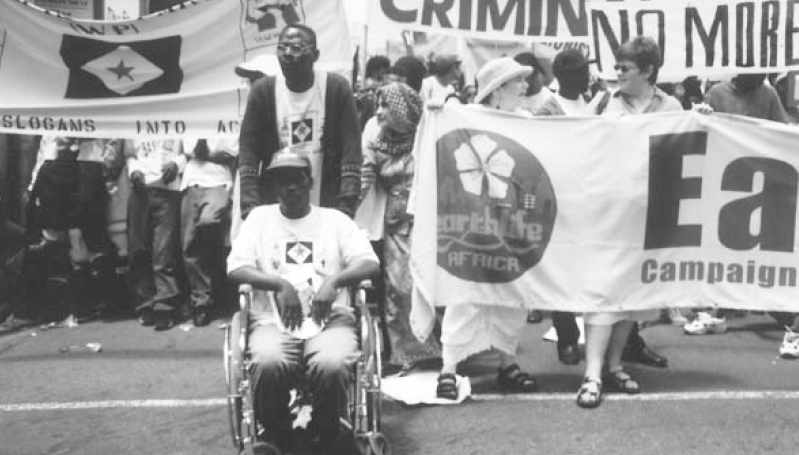
The Social Movement Indaba (SMI) and its member organisations were invited to participate in the Second Edition of the ASF, the People’s Forum in Mauritius and the World Social Forum in Porto Alegre. The delegation to the ASF included the Anti- Privatisation Forum, Jubilee South Africa, Khanya College and the Western Cape Anti- Evictions Campaign (WAEC).
Composition of ASF
The composition of the ASF has two distinct forces. The one group included those with more radical politics and an orientation to closer links with the emerging social movements. These delegates were largely from Southern African countries. The other group led by ngos, particularly from French speaking West Africa, did not have relationships to mass organizations, but they were the majority in the ASF. The first group argued that the ASF should focus on building social movements that would struggle against NEPAD, while the latter wanted to participate in the government and/or other power structures as a way of influencing government policy.
Debates and differences in the ASF
The first edition of the ASF in Bamako, Mali, rejected NEPAD as a neoliberal project, in January 2002. The second edition reaffirmed this rejection and committed itself to developing alternatives. The problem was translating this rejection into political practice and strategy and this bedeviled the entire ASF proceedings.
- Participation in the African Union
Ammara Essy, the interim chairperson of the African Union (AU) Commission, delivered the opening address of the forum, and invited the ASF to participate in the AU civil society structures. This raised a big debate in the ASF. A minority opposed the opening address by the AU speaker, and argued that the ASF was part of the anti-globalisation movement, an independent movement based on mass orientation. Secondly, the ASF still needed to define its objectives, strategies, friends and enemies. In contrast, the AU adopted NEPAD as its political and economic programme in South Africa in July 2002. The AU’s address was therefore an attempt to co-opt the ASF into the AU’s neoliberal processes. The other position argued that the AU is an important body that gives Africans a chance for unity and therefore the ASF should participate in the civil society structures of the AU. Some people who support this view argued that NEPAD is not yet the official economic policy of the AU and that there is still space to shape the economic policy of the AU.
The discussion on the role and participation of the AU was then taken into a working group, and later the plenary session. But the matter was not resolved. However, the ASF organisers withdrew invitations to the AU ambassadors to participate in the ASF because of the divisions on the AU.
- UNDP Millenium Objectives
The organisers also invited the UN Development Programme (UNDP) to present the Millennium Objectives, its ‘developmental’ programme, and this raised debate. The programme is similar to NEPAD in that it does not talk about cancellation of the debt but debt relief, and it does not call for poverty eradication but for poverty reduction.
NGOs and civil society are requested to monitor the implementation of the programme in their countries according to the UNDP. There was disagreement on whether the ASF should ‘engage’ with the UNDP’s Millennium Objectives or not.
Consensus Agreements
There was consensus reached on some issues
- A total rejection of all forms of privatisation of social services in Africa. It was further argued that social services are part of our human rights to life and dignity.
- A demand for debt cancellation and repara- tions. Debt was seen as instrument of control and domination imposed by the imperialist forces and their institutions. The meeting agreed that there should be mass mobilisation for debt repudiation.
- On the Fair and Transparent Arbitration Campaign to form a panel to conduct arbitra- tion on the debt question: The majority decision rejected this campaign because it undermines the struggle for debt cancellation and reparation, and argued that the principle is that the debt is odious and illegitimate.
- Opposition to trade liberalisation imposed by the WTO on Africa as trade liberalisation has destroyed Africa’s agriculture and emerging industries.
- The forum also noted that farmers and people in Africa in general, do not benefit from AGOA/Cotonou type of trade agreements.
- The ASF committed itself to working to- gether with other social forums in Europe, Asia, North America and Latin America to build a better world.
The ASF structure
The issue of the structure of the ASF was not resolved and the status quo prevails, based on representation from thematic groups and regions. The Southern Africa position was that a new council be elected, providing for substantial representatives from the anti-neoliberal mass movements. This did not preclude the representation of thematic groups such as trade, debt, agriculture, etc.
Assessing the SMI’s Approach to the ASF
The ASF is not based on radical politics and an orientation to the social movements. Together with other participants from Zimbabwe, Swaziland, Kenya and Ethiopia, the delegation tried to influence the ASF in a more radical direction. There is agreement on the need to survey and link up with more radical organisations in French-speaking Africa. This would also assist in bridging the regional and language divide.
There were some important issues that were not discussed in the ASF. For example, these included the AGOA, the Palestinian question and the War on Iraq. There was also no relationship between the ASF and the People’s Forum meeting that was opposed to AGOA, and was taking place in at the same time in Mauritius. This robbed us of an opportunity to make the links between AGOA, the NEPAD and the AU.
*Mondli Hlatshwayo is an activist in the APF and works at Khanya College.
Leave a Reply
You must be logged in to post a comment.