
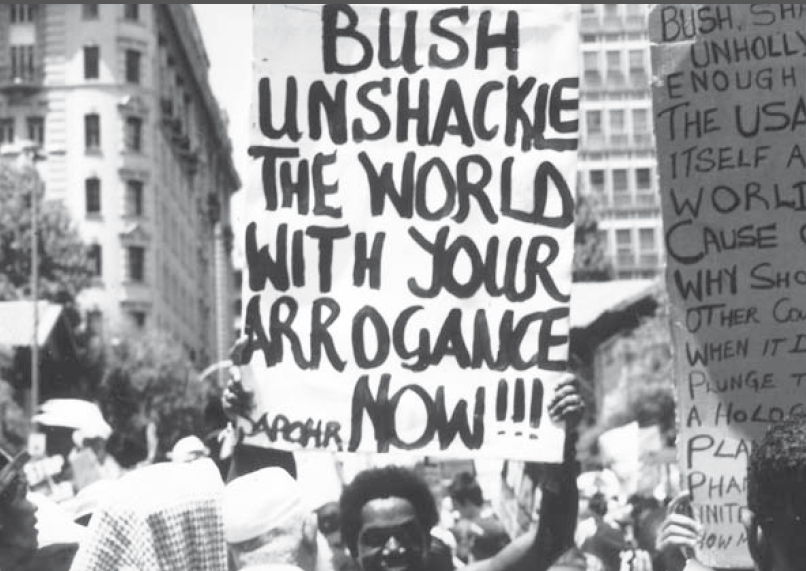
Joel Kovel* argues that the popular anti-war movement in the US is a reflection of the growing disaffection among the disempowered in the US.
Observers who have grown accustomed to pronouncing the death of the US left had reason to be shocked when between
300,000 and 500,000 marchers showed up on a freezing January day in Washington, DC, to tell George W Bush that they were not going to stand for his imminent war-making in Iraq. The marchers in Washington were part of a number of other marches in San Francisco and smaller venues across the country, This was only the most visible side to a startling resurgence that has included the passage of anti-war resolutions by 52 city councils by early February, including Chicago (which passed the resolution by a vote of 46 to 1), and San Francisco, as well as stirrings from labour organizations representing more than four million workers. This is significant because the unions have long appeared as politically moribund, indeed, shamefully supported US intervention in Vietnam.
The scale of the demonstrations is correctly compared to those of the Vietnam war era, the last such instances of major anti-war protest. Indeed, excepting the very large (and less confrontational) anti-nuclear demonstrations of the early 1980s, the present demonstrations are the largest since the late 1960s. however, this fact obscures a remarkable difference between the present protests and those of the late 1960s. The Vietnam-era actions were a reaction to an ongoing bloody conflict in which hundreds of US troops—mainly, involuntary conscriptees, were coming home each week in body bags, while images of destroyed villages were being broadcast daily on television. The war, moreover, had been proceeding full-blast for some five years before demonstrations on the scale of a half-million participants took place. This time, the war had not even begun, the draft was a dim memory, and the armed forces have been thoroughly professionalized. While the damage inflicted on Iraq by US-sponsored sanctions is a terrible reality, thanks to iron media censorship it has had little immediacy for the public and could only have played a small role in bringing out so many demonstrators.
The Vietnam Syndrome
The defeat in SouthEast Asia was said to have induced an illness in the American people, the chief symptom of which was aversion to being involved in war: the dreadful “Vietnam Syndrome.“ To cure the citizens from this affliction, the authorities promised that in the future hardly any Americans would be killed in battle, while the US would only fight wars in which it could win massively and quickly. In addition, the image of war American style would be ruthlessly sanitized and made to seem humanitarian. Yet despite strenuous activity by the spin doctors in the Gulf, Kosovo and Afghanistan wars, the Vietnam syndrome refuses to go away. Neither the fear and general defensiveness following 9-11 nor the obnoxiousness of Saddam Hussein have generated more than lukewarm acquiescence amongst those who support Bush on Iraq. Meanwhile extraordinary numbers show up in the nation’s capital to rage against a war that has not even begun. What gives?
The answer lies in a combination of factors: George W. Bush’s extraordinary divisiveness, his severe lack of legitimacy as perceived by substantial sectors (though still a minority) of the population, and the grandiose and reckless aggressiveness of US foreign policy during his administration, especially in Iraq. These factors are a package that, in turn derives from structural shifts in US politics over the last 25 years.
The Two Party System
The American political system has long shown a genius for keeping the nation on an even keel by absorbing conflict, chiefly through the elaborate shadow-play devised by the two party system. Thanks to the peculiarities of American politics, it is extremely difficult for serious alternative views to be placed before the public. At the same time, the exceptionally servile media system also suppresses alternative views while inflating the actual differences between the mainstream Republican and Democrat parties.
Effectively, then, a narrow and elite consensus has come to define politics, garnished as it may be with ritual combat, chiefly over the spoils of office. Consequently, increasing numbers of people—now well over half the electorate–have simply ceased to participate in elections, which have become correspondingly dominated by ever greater blocks of money. This in turn greatly favors the Republicans, whose primary constituency is the affluent. Increasingly, the people who go to the polls on election day represent a narrow bourgeois sector, principally suburban in origin, whose political horizon is pretty much defined by dominant business interests.
Meanwhile, the Democrats, party of “the People,“ have found themselves increasingly without people to represent, and led to continually ape the Republicans, without, however, the sincerity of the former. Continual bad faith and opportunism have eaten away at the authenticity of the Democratic Party, left it a shell of its former self, and allowed aggressive reactionaries to define the national debate.
Rightward Shift in US Politics
For the past 25 years, therefore, the “center“ to which the system gravitates has moved rightward to a remarkable degree. This has happened because of these political drifts, but equally from the exigencies of a prolonged crisis in capitalism that has forced elites to intensify the degree of exploitation of labor and nature, and cut back on social spending. Another contributing factor was the end of the cold war, which left the US as the sole standing superpower, with no further need to compete ideologically against Soviet appeals to the dispossessed of the earth. From the latter part of the Carter administration, through Reagan and the first Bush, and into the two terms of the right- wing Democrat Clinton, the notion that government represents the interests and aspirations of ordinary people deteriorated. As a result, the very fabric of American democracy has steadily broken down, and with it, the ability to contain conflict by driving it to the political center.
George W. Bush is both the product and the accelerant of this tendency. No US president has ever done less to deserve his high office, which was handed to him strictly because of privilege. The 43rd President possesses all the arrogance of a
hereditary monarch, enhanced by a fundamentalist Christian belief that ensures the divine ratification of whatever he feels like doing. Bush does manage to project a populist cowboy image. This translates, however, not into regard for the people, but into the recklessness of the Wild West, whence the whole world has been made to tremble because of his lawless gunslinging.
The malignancy of Bush’s Iraq policy was presaged in the extraordinary circumstances of his coming to power in 2000. A strong progressive Democrat could have trounced this singularly unworthy individual, but in Al Gore the Democrats had a man who had assumed all the structural weaknesses to which the party was prone. Even so, Gore won the popular vote by a substantial margin, and would have won the whole prize if all those who set out to vote Democratic that day in the state of Florida (governed by Bush’s brother) had had their votes counted. Instead, the Bush team simply stole the election, as the startling spectacle of a coup d’etât unfolded in full view of the American people and with the open connivance of the Supreme Court. With this shocking start to the new adminstration, polarization became the order of the day. Instead of the “lesser of two evils“ that is Democratic opportunism, Americans of progressive inclination found their faces thrust into “the greater of two evils“: a president who had come to power lawlessly and outside of democratic channels.
With this gross abandonment of democracy, the American political system also lost a major instrument for restraining and absorbing protest.
Anti-Bush sentiment grows
As the center of US politics unravelled, significant disaffection began to appear amongst the disempowered. George W Bush has the dubious distinction of being the first President ever to have been so heckled at his inauguration (“Hail to the Thief!“) as to have been forced to stay in his limousine the length of the parade route, and made to slink into his new home. Then the overture of lawlessness with which his adminstration began rapidly evolved into sheer gangsterism with the revelation of unprecedented corporate scandal, including firms like Enron, symbiotically close to the President. More, in the context of a fresh downturn following the collapse of the Clinton- era speculative bubble, the Bush gang proceeded to loot the national coffers with massive tax cuts, accelerated the normal capitalist rape of the environment, and has been driving the economy toward ruin with aggravated military spending. The greater of the two evils had become a full- blown disaster.
The catastrophe of 9-11 proved a godsend to
Bush, providing him with a `War on Terror` with which to distract people from the misdeeds and incompetence of his administration and, indeed, the entire capitalist class he represents. It also set him on a path whose only outcome is the steady projection of US jingoism and militarism, along with associated domestic repression. Needless to say, this suits Bush’s Wild West mentality excellently—but it also places him on a collision course with an increasingly outraged and disaffected fraction of the public and drives them to the left, even as the sublimely indifferent President ignores them.
Such are the chief dynamics of the current surge of the anti-war movement. It goes without saying that present conditions are highly volatile and unpredictable at all levels. Fundamentally, the drive of Bush toward domination of the Middle East is driven by hunger for oil. But this is not simple greed, rather, the product of a gathering crisis of world-historical proportions: the drawing to an end of the petroleum-driven industrial empire. There is therefore an underlying desperation to American aggression, which only makes it all the more dangerous.
The fate of the anti-war movement in the United States is very much in the balance. Significant divisions, between Marxist-Leninist factions, liberals, and the traditional peace movements, remain to be resolved. More basically, the movement as a whole needs to find its identity in relation to the world-wide uprising against global capital. What is not in dispute is that we have entered upon times of heightened possibility as well as heightened danger—the very definition of a crisis.
* Joel Kovel is a socialist active in the social movements
Leave a Reply
You must be logged in to post a comment.